Can a Retail Trader Compete With Institutional Quants?
· #systematic-trading #retail-trading #trading-psychology #research-method #risk-management
Not on speed, data, or capital. A retail trader loses all three of those races before they start, and pretending otherwise is the most expensive mistake available. What is left is a real game: patience, selectivity, and the freedom to trade nothing at all. I cannot out-execute a bank. I can afford to wait, and a bank usually cannot.
As a self taught quant trader I spent longer than I should have trying to win the wrong race. What follows is what I found on the other side of accepting that, including the parts of my own research that went against me.
Where does a retail trader actually lose to an institution?
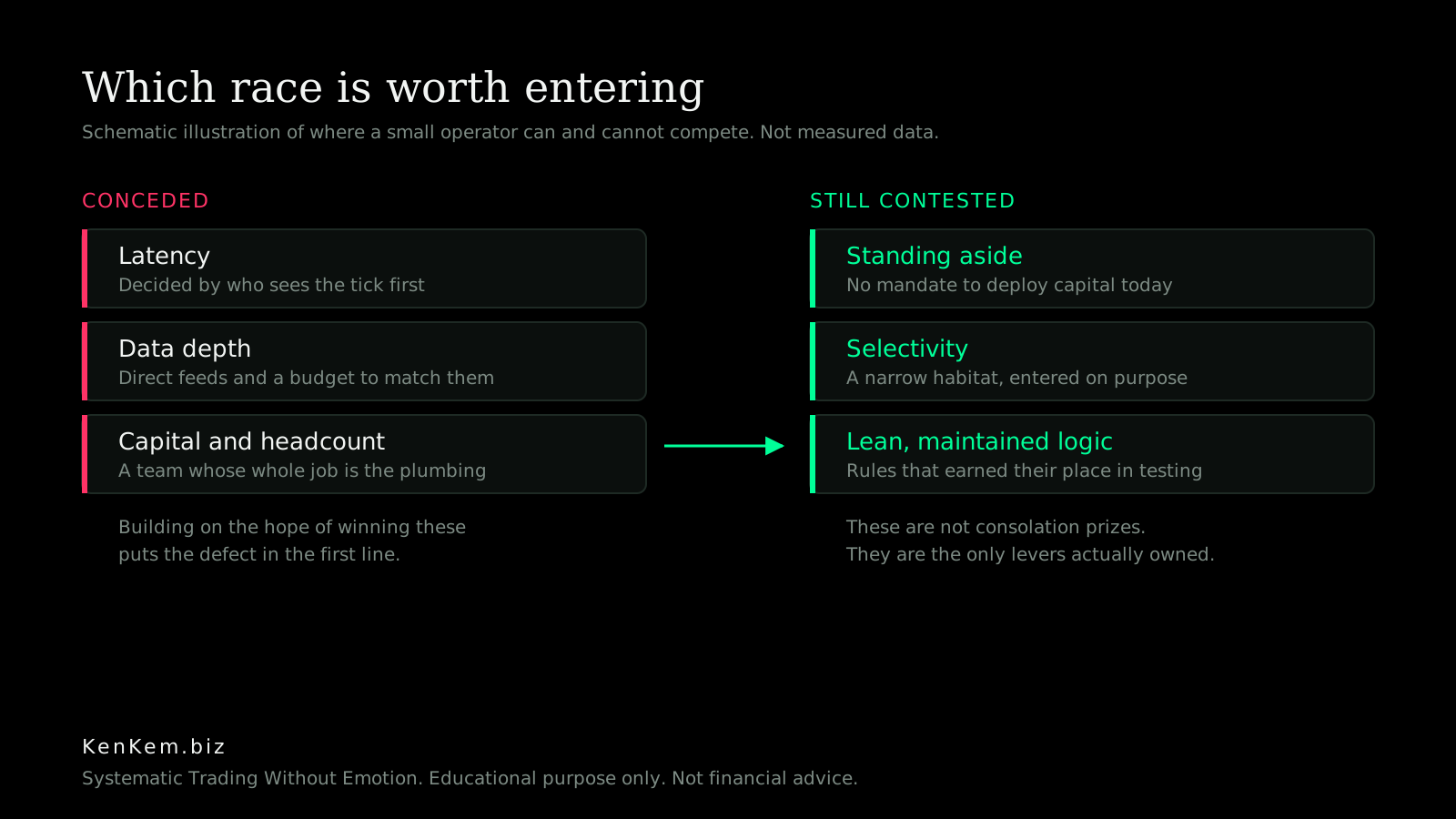
On infrastructure, and it is not close.
I do not have direct exchange feeds. I do not have sub-microsecond latency. I do not have a Tier-1 data budget or a team of people whose whole job is the plumbing underneath the strategy. Any part of the market where the winner is decided by who sees the tick first is a part of the market I have already lost, and no amount of cleverness in my code changes that.
The useful move is to say it plainly rather than to work around it emotionally. A strategy built on the quiet assumption that you will somehow get there first is a strategy with a defect in its first line. Accepting the limit is not defeatism, it is the first honest input to the design.
What is left once you stop racing on speed?
The right to be selective, and the right to sit out entirely.
This is the part that took me longest to value properly. A desk deploying capital has a mandate to deploy it. I have no mandate at all. I can look at a day, decide the conditions are wrong, and do nothing, and nobody asks me why my capital was idle. Standing aside is not a missing feature in a small operation. It is close to the only structural advantage a small operation has.
I eventually coded that instead of feeling it. The execution side of my work now stands aside on days where the measured cost of trading, spread relative to volatility, runs too hot to be worth it. Paired with a rule that reduces position size while the account sits below its equity peak, that took maximum drawdown on a hostile two and a half year test window from roughly 57 percent down to roughly 22 percent, and every half-year fold in the window improved or held. Those are backtest and MetaTrader 5 confirmation figures on real historical ticks, not a live record.
The reason a cost filter matters that much is visible in 2024. In that year the spread on gold ran at about 8.6 percent of average true range, roughly twice what the logic was built in, and the same unchanged rules lost 67.1 percent with a maximum drawdown of 74.2 percent under MetaTrader 5 confirmation. Nothing about the strategy broke. The cost of doing business changed, and a thin edge has no room to absorb that. A retail trader who can simply decline to participate on those days is using the one lever he actually owns.
Why does complexity hurt a retail system more than an institutional one?
Because I am the only person who will ever maintain it.
A large team can afford a model that needs constant feeding. I cannot. Every extra rule is more data, more compute, more surface area for a silent bug, and more of me needed to keep it alive. So the standard I hold is narrow: if a rule does not measurably improve risk-adjusted behaviour or reduce drawdown, it does not go in, however sensible it sounds.
A concrete example, because the principle is easy to state and hard to follow. I tested the Kaufman Efficiency Ratio as an entry filter. It is a reasonable idea, it is well known, and it produced no out-of-sample lift in my testing, so it is not in the product. There is nothing clever about that decision. It is just the difference between testing a rule and liking a rule.
Simplicity has also won a measured contest in my own work, which surprised me. When I compared a fixed configuration against re-optimizing the parameters on every walk-forward fold, the fixed configuration came out ahead, positive in five of five folds against four of five for the re-optimized version. The more adaptive-sounding approach was the worse one. It took me quite a while to build my own DQuants framework to significantly speed up the entire development process from hypothesis validation all the way to deployment, and the main thing that speed buys is the ability to find results like that instead of assuming them.
Why did I stop looking for a perfect system?
Because I found something more useful than a perfect system, which is a repeatable process.
I spent years looking for the always-right entry and the zero-drawdown curve. The market is full of systems that looked exactly like that until the first violent change in conditions. What survives is not a better guess, it is a method that keeps producing verdicts you did not want to hear.
Most of my process output is rejection. Attempts to bank profits earlier have now been falsified eight separate times in my research, and the most recent round tested a daily loss cutoff, a hard drawdown halt, and lower profit targets. All three were rejected, and the attempt came out with worse drawdown than leaving the rules alone. That is the sort of result that only exists if you pre-register the test and then actually read the answer.
The same discipline has to point at my own evidence, and that is harder. I asked for a hostile external review of my process rather than my results. The finding that landed worst was that the robustness statistic I cited most often, the deflated Sharpe ratio, was arithmetically incapable of failing at my recorded parameters, so a perfect score from it carried no information at all. Meanwhile the test with genuine discriminating power, the probability of backtest overfitting, had failed in eight of nine cross-validation cells, and I had talked my way past it. None of that makes the edge fake. It means my evidence could not demonstrate that it was real, while my documents were written as though it could. The saturated number no longer leads, and the one that can fail does.
How does automation actually protect a trader from himself?
By making the decision before the moment arrives, when you are still calm enough to make it well.
The felt version of this problem is familiar to anyone who has traded manually with real money. Price runs against you, and the stop you set an hour ago starts to look unreasonable. You move it. Or you take a loss and something in you wants it back from the market immediately, so the next entry is not a decision at all. Willpower is a resource, and it is at its lowest exactly when the market demands the most of it.
A coded rule does not get tired and does not want revenge. Instead of a feeling, I get a log line saying the trade was vetoed because a condition was not met, and the argument is over. Risk limits, session windows, and position caps run whether or not I am at the screen, which is the actual point of them. Deciding your maximum daily risk while nothing is happening is a completely different act from deciding it during a drawdown.
The honest limit is that automation does not remove judgment. It relocates it. Every emotional decision you were making per trade now lives in the configuration, and in whether you can leave that configuration alone for long enough to learn anything from it. Plenty of people automate a system and then override it manually, which reproduces the original problem with more steps. The software cannot help with that part. That part is still you.
What does an honest retail product look like?
Like a tool that helps you read the present, not one that claims to predict the future.
I have watched trading marketplaces for years, and they hold two kinds of product. There are the ones that promise the moon, and there are the ones that give a trader structure. The second kind is what lasts, mostly because it can survive its own users checking it.
That is the line I try to build on. The MasterVP Profiler is an indicator, on TradingView and on MetaTrader 5. It draws volume context and chart structure so a trader can see the auction more clearly, and it leaves the order with you. It is not a signal service. Execution is a separate product on the Expert Advisor side, and it trades only the rules the user configures, including their own risk per trade, daily risk limits, and sessions. Those roles stay distinct on purpose, because blurring them is how a tool ends up sounding like a promise.
Honesty about limits belongs on the label rather than in a footnote. The mean-reversion leg of my gold work runs on 51 trades, far below the 192-trade minimum I use before I trust a sample, so it is not independently significant and I do not present it as half the engine. There is no live track record behind any of this either. Everything above is backtest and confirmation work on real historical tick data, and live should be expected to be thinner than research, because my cost model charges spread on every trade but does not yet model slippage, latency, or swap.
Why is detachment worth more than conviction?
Because conviction is precisely the thing that breaks you during a drawdown.
If you are emotionally attached to every tick, a bad week is a personal event and you will eventually do something expensive about it. If you are attached to the process, a bad week is a data point you expected. The quiet mind is not a personality trait some traders are born with. It is what is left over when the decisions have already been made and written down.
The numbers make the case better than the sentiment does. In my calendar-month walk-forward, 11 of 12 months came out profitable with a median profit factor around 1.34, and the interesting month is the twelfth. August 2025 finished at a profit factor of 0.69 and down 21.6 percent, sitting inside a window I would otherwise be tempted to call strong. A losing month is not a defect to engineer away. It is the shape of the thing, and knowing that in advance is most of what detachment actually is.
What would I say to someone worn down by FOMO?
That the way out is one rule and a test, and that it is slower than it sounds.
I have lost money to FOMO. It feels like the market is picking on you specifically, and it feels like everyone else has understood something you have not. The path away from it is not a stronger conviction or a better indicator. It is one written rule, then a backtest that subtracts commission and spread honestly, then a small run at size you will not miss. Then the second rule.
That order is genuinely boring, and boring is the feature. Nothing in it requires you to be right about the next move, which is the whole reason it works when confidence does not. Serious progress here looks unremarkable long before it looks impressive, and if it looks impressive early, that is usually a sample size problem rather than a discovery.
Frequently asked questions
Can a retail trader realistically compete with institutional quants? Not on the dimensions institutions are built to win. Speed, data quality, and capital are decided by infrastructure budgets, and a retail operation loses all three. What a small operator does own is selectivity and the option to not trade, because there is no mandate to deploy capital. That is a narrower game, but it is a real one.
What is the biggest advantage a retail trader has? The ability to sit out. In my own work, adding a rule that stands aside when the measured cost of trading runs too high, together with a rule that cuts position size below the equity peak, took maximum drawdown on a hostile two and a half year test window from roughly 57 percent to roughly 22 percent. Those are backtest and confirmation figures, not live results.
Why does a simpler trading system often beat a more complex one? Because complexity has a maintenance cost that a solo operator pays personally, and because extra parameters make it easier to fit the past. When I compared a fixed configuration against re-optimizing on every walk-forward fold, the fixed one was positive in five of five folds and the re-optimized one in four of five. The more adaptive approach measured worse.
How do you decide whether a rule belongs in a strategy? It has to measurably improve risk-adjusted behaviour or reduce drawdown out of sample. Sounding sensible is not enough. I tested the Kaufman Efficiency Ratio as an entry filter, found no out-of-sample lift, and left it out.
Does automation remove emotion from trading? It relocates it rather than removing it. The per-trade decisions move into a configuration you write while calm, which is a genuine improvement, but the emotion reappears as the temptation to override the system during a drawdown. Software cannot solve that part.
Why do trading costs matter so much to a small edge? Because when the average win is close to the size of the average loss, cost is the margin rather than a rounding error. In 2024 the spread on gold ran at roughly 8.6 percent of average true range, about twice the level the logic was built in, and the unchanged rules lost 67.1 percent with a 74.2 percent maximum drawdown in MetaTrader 5 confirmation.
Is a losing month evidence that a system has stopped working? Usually not by itself. In my calendar-month walk-forward, 11 of 12 months were profitable with a median profit factor near 1.34, and the worst finished at a profit factor of 0.69 and down 21.6 percent. A record with no bad month more often means the window is too short than that the system is unusually good.
Which part of MasterVP reads the chart, and which part trades? Both halves exist, and the split matters. The MasterVP Profiler is the indicator, on TradingView and on MetaTrader 5: it shows you the read, where volume actually traded and how the chart is structured, and it leaves the order with you. It is not a signal service. Execution lives on the Expert Advisor side, and it trades only the rules a user configures for themselves.
Is there a live track record behind these numbers? No, and I will not imply one. Every figure above comes from backtests and MetaTrader 5 confirmation runs on real historical tick data, or from an external audit of my process. Live results should be expected to be thinner than research, because slippage, latency, and swap are not yet in my cost model. Trading involves risk including the risk of loss.
Written by KenKem, a software engineer and founder of twenty years, learning quantitative trading in the open and publishing the process, rejections included.
This article was composed from the KenKem build-log series. Educational purpose only. Not financial advice. All figures cited are backtest, confirmation-run or audit results, not a live track record. Past performance does not guarantee future results.