Why Does a Gold Scalp Start in the Red?
· #trading-costs #xauusd #scalping #session-filters #systematic-trading
Because the round trip is charged before the idea is right about anything. On XAUUSD a pip is 0.01, and depending on the hour and the broker the spread I see runs somewhere between 15 and 57 pips, so a full round trip commonly costs 30 to 60 pips. Every trade pays that fee, good idea or bad.
As a self taught quant trader I assumed for a long time that better entries were the answer. The two changes that moved my gold work the most were not entries at all. They were a cost model I refuse to relax, and a set of hours I stopped trading completely.
What does a gold round trip actually cost?
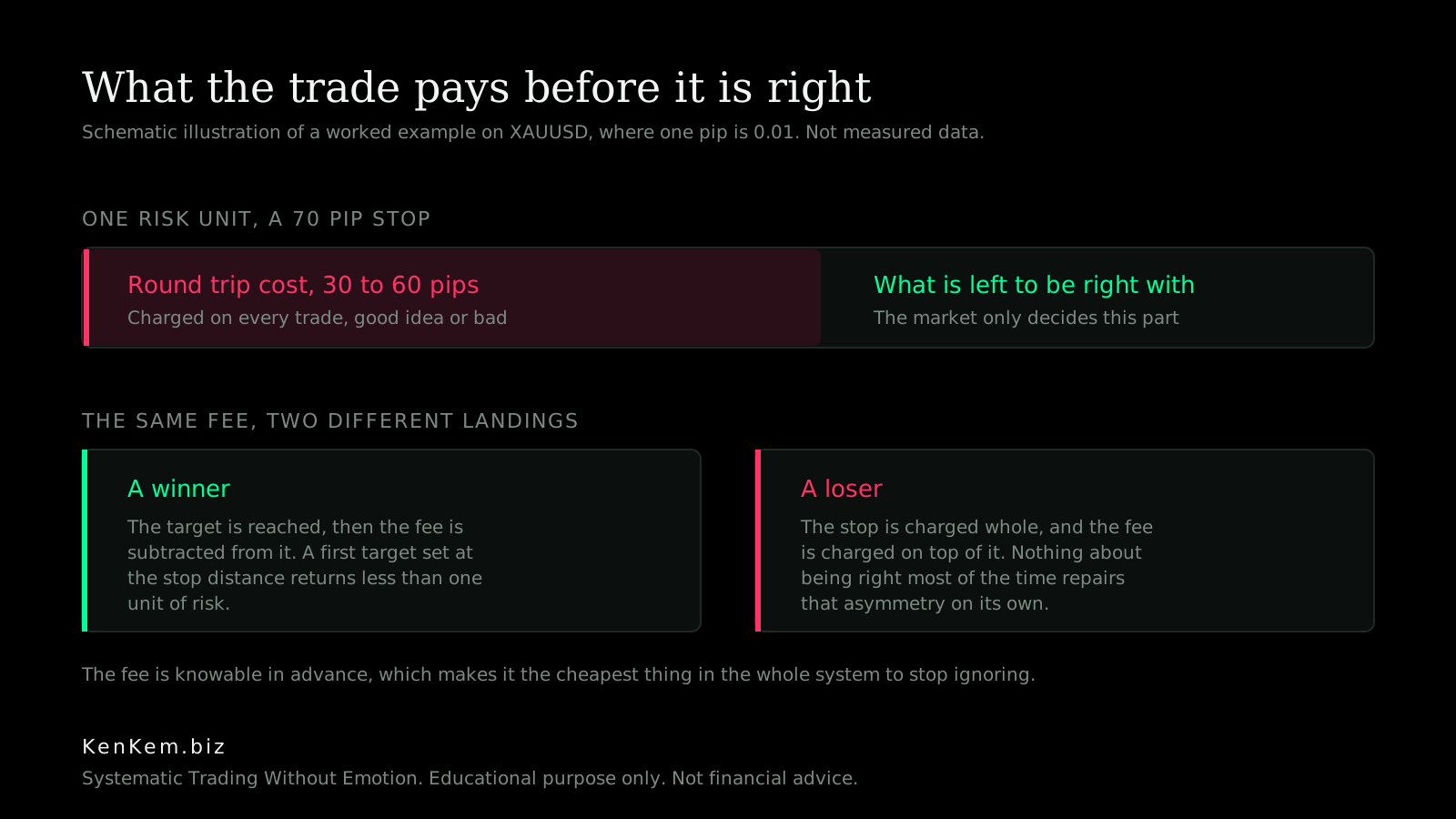
Somewhere between 30 and 60 pips in the conditions I see, and the important part is that it is knowable in advance.
Put that next to a stop and the problem stops being abstract. Take a stop sitting 70 pips away, purely as an illustration and not as a setting I am recommending. A 40 pip round trip has already eaten more than half of that risk unit before price has moved at all. The trade now has to be substantially right just to get back to flat. That is not a complaint about brokers. It is an entry fee, published in the spread, payable on every trade.
Most of the scalping strategies I tested did not die from bad entries. They died from being measured without their entry fee. So in the DQuants engine I built, spread is charged on every simulated trade, and I treat live conditions as thinner than the backtest rather than richer.
Why does a tight first target behave like a coin flip?
Because the fee is subtracted from every win and charged in full on every loss.
Take the same arithmetic. If the round trip costs 40 pips and the stop is 70 pips, then a first target set at that same 70 pips does not return one unit of risk. It returns what is left after the fee, and that gap is what decides whether a high win rate actually pays for itself. This is exactly why win rate on its own tells me almost nothing. A strategy can be right most of the time and still bleed, if every win is quietly shaved and every loss is charged whole.
The question worth asking about a first target is not how often it hits. It is how much survives the fee when it does. A target that does not clear the cost with real margin is not a target, it is a coin flip with extra steps.
How tight is too tight for a stop on gold?
There is a distance below which spread stops being a cost and becomes the strategy.
The logic is simple. The tighter the stop, the larger the fraction of it the round trip consumes, and the more of the outcome is decided by the fee rather than by the market. Past a point, tightening the stop does not reduce risk. It just moves the decision away from the idea and onto the spread.
There is a second reason a very tight stop struggles on gold, and it has nothing to do with cost. A stop parked just inside the recent swing sits exactly where ordinary noise reaches. Getting taken out there is not bad luck, it is the stop being placed in the busiest part of the chart. A stop has two jobs: to be wrong cheaply, and to be far enough out that the fee and the noise are not the ones making the decision. In my own gold research I hold a floor on the stop distance for that reason, and I place it beyond the recent swing rather than inside the wick zone.
Which dial makes a mediocre backtest look good?
The cost assumption, not the entry logic.
Zero cost, or light slippage, turns an ordinary scalper into a good looking one on screen. Nothing about the strategy changed. It simply stopped being charged for existing. That is the dial, and it is the one I fix before the result is looked at rather than after.
It took me quite a while to build my own DQuants framework to significantly speed up the entire development process from hypothesis validation all the way to deployment, and the cost model is the single setting in it I will not touch once a result is on screen. Spread is charged on every trade, live is assumed thinner than the test, and a configuration has to clear its bar at that realistic cost on a genuinely separate out of sample window. A number produced on a friendly window at a friendly cost is not evidence, it is a picture. That rule is why I reject far more strategies than I keep, and why the ones I keep get published with their drawdown attached rather than without it.
Why did I delete a third of the trading day?
Because the hours did not match what the method was asking the market to do.
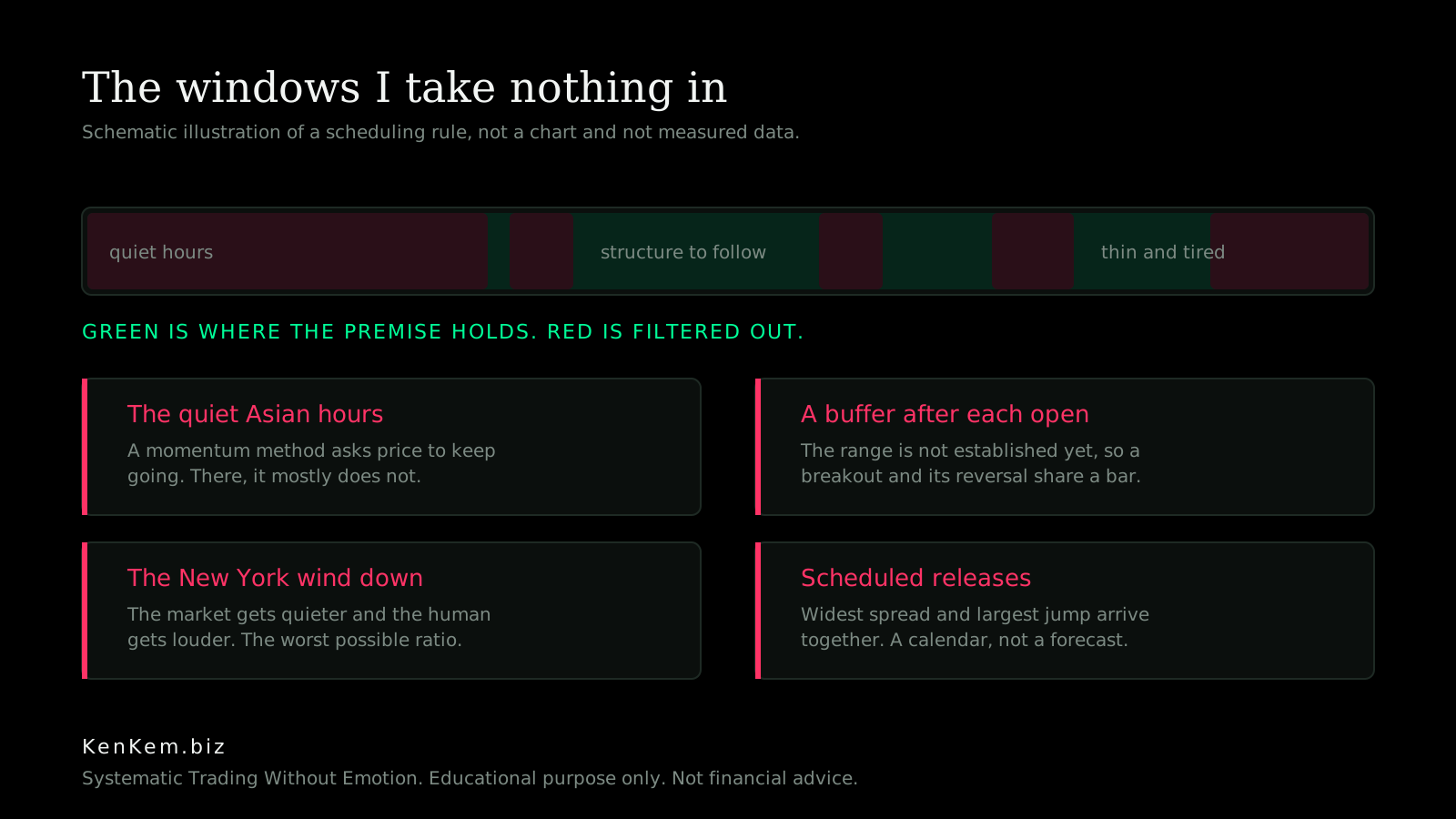
The Asian hours on gold are usually quiet and mean reverting. A momentum continuation approach asks price to keep going, and in those hours it mostly does not. Every signal still fires, the fees are still charged, and the outcome sits close to noise. So that window is off by default in my work. Not because those hours are bad in some absolute sense, but because they contradict the premise the strategy runs on.
The market does not owe a strategy the same behaviour all day. Matching a method to the hours it was designed for beats tuning entries inside hours where the premise is false. The session gate is one of the first things I check when a configuration underperforms, before I touch a single entry parameter.
Why do I skip the first minutes of a session?
Because a session open is not the session. It is the argument before the session.
When a major session opens, the first stretch tends to be the market finding out what it thinks. Levels get taken and given back, the range is not established yet, and a breakout and its reversal can happen inside the same few bars. A method built to follow structure has almost no structure to follow yet.
So I buffer the open rather than trade it. Waiting costs a handful of signals. Not waiting costs those same signals plus their fees, in the exact window where they are least likely to mean anything. Being early to a session is not an edge, and I do not need to be in that argument.
What is wrong with the last hour of New York?
The market gets quieter and the human gets louder, which is the worst possible ratio.
Volume thins, participants close up, and the moves that do appear are often positioning rather than direction. It is also the hour when a trader who is down on the day is most likely to reach for one more trade, in the conditions least able to support it. So I treat the wind down as closed rather than as one last chance.
The hours I most wanted to trade were rarely the hours the data supported. Writing the rule down in advance was the only thing that reliably stopped me, and that is the whole reason I moved to an algorithmic approach in the first place. The rule does not get tired, and it does not want to make the day back.
Why stand aside for scheduled releases?
Because gold does not drift through a major economic number. It jumps.
Around the big scheduled releases, moves of one to three hundred pips are ordinary, and the spread widens at the same moment. Both halves of that matter. The move can clear a stop in a direction that had nothing to do with the setup, and the fee to be in the trade at all is at its highest exactly when the fill is at its worst.
None of that is a forecast. It is a published calendar, which makes standing aside a scheduling decision rather than a prediction. There is a real difference between a strategy that survives news and a strategy that simply was not in the market for it, and I would rather be honest about which one I built.
What does treating cost and time as inputs actually change?
Fewer trades, and a much smaller tail of losses I could not explain afterwards.
It does not turn a weak idea into a strong one. Nothing does. What it does is stop the two largest, most predictable leaks from being invisible in the research: a fee that is charged whether or not the idea was any good, and a set of hours where the premise of the method is simply not true. Both are knowable before the trade. Neither requires a forecast. That is why they are the first two things I fix and the last two things I would loosen.
Frequently asked questions
What does a XAUUSD round trip cost in pips? In the conditions I trade and research, commonly 30 to 60 pips for a full round trip. On gold a pip is 0.01, and the spread I observe varies with the hour and the broker across roughly a 15 to 57 pip range, so the cost is a range rather than a constant. The figure that matters is not the spread on its own, it is the spread expressed as a fraction of the stop distance.
Why does a high win rate not mean a strategy is profitable? Because the cost is asymmetric in how it lands. Every winner is reduced by the round trip and every loser is charged the full stop plus that same round trip, so a target that only just clears the fee returns less than one unit of risk while the loss stays whole. A strategy can be right most of the time and still lose money, which is why I do not lead with win rate.
How tight can a scalping stop be before spread dominates it? There is no universal number, but the test is a ratio rather than a distance. Once the round trip consumes a large fraction of the stop, the spread rather than the market is deciding most outcomes, and tightening further does not reduce risk. In my own gold research I keep a floor on stop distance and place it beyond the recent swing instead of inside the zone where ordinary wicks reach.
Should I trade the Asian session on gold? That depends entirely on what your method assumes, and it is your decision to make, not mine. What I can say is what I found in my own work: the Asian hours on gold are usually quiet and mean reverting, so a momentum continuation approach is asking for behaviour those hours mostly do not supply. My systems have that window off by default for that reason and no other.
What happens in the first fifteen minutes after a session opens? Because the range is not established yet. Levels get taken and given back, and a breakout and its reversal can occur inside the same handful of bars, so a structure following method has very little structure to work with. Buffering the open costs a few signals, and taking those signals costs the same signals plus their fees at the least informative moment of the session.
How do you handle high impact news as a systematic trader? As a scheduling problem, not a forecasting one. The releases are published in advance, so my systems filter a window around them and take nothing inside it. Around those releases moves of one to three hundred pips are ordinary while the spread widens at the same time, which means the worst fill and the largest unexplained move tend to arrive together.
Which part of MasterVP reads the chart, and which part trades? Both exist, and the split matters. The MasterVP Profiler is the indicator, on TradingView and on MetaTrader 5: it shows you the read, where volume actually traded and how the chart is structured, and it leaves the order with you. It is not a signal service. Execution lives on the Expert Advisor side, MasterVP Sniper on the MQL5 market, and that trades only the rules a user configures for themselves.
Are any of these figures a live track record? No. Everything above is research arithmetic and backtest discipline, not a record of live returns, and I will not imply otherwise. Spread ranges are observed conditions, the 40 against 70 pip comparison is a worked example rather than a result, and my own cost model still assumes live conditions are thinner than the test rather than richer.
Written by KenKem, a software engineer and founder of twenty years, learning quantitative trading in the open and publishing the process, rejections included.
This article was composed from the scalper cost and session posts of the KenKem build-log series. Educational purpose only. Not financial advice. Figures cited are observed trading conditions and worked examples, not a live track record. Past performance does not guarantee future results.