
Why Does Structure Beat Discipline in Trading?
· #trading-psychology #risk-management #systematic-trading #research-method #backtesting
Structure beats discipline because discipline is a resource you spend and structure is a decision you make once. A coded constraint does not get tired, does not want revenge after a loss, and does not renegotiate itself at the worst possible moment. The harder half of the claim is that a constraint only helps if it was measured, and several of mine were rejected.
What follows is how I moved the decision from the moment of pressure to the point of design, and the falsifications that taught me the difference between a rule that protects and a rule that merely feels protective.
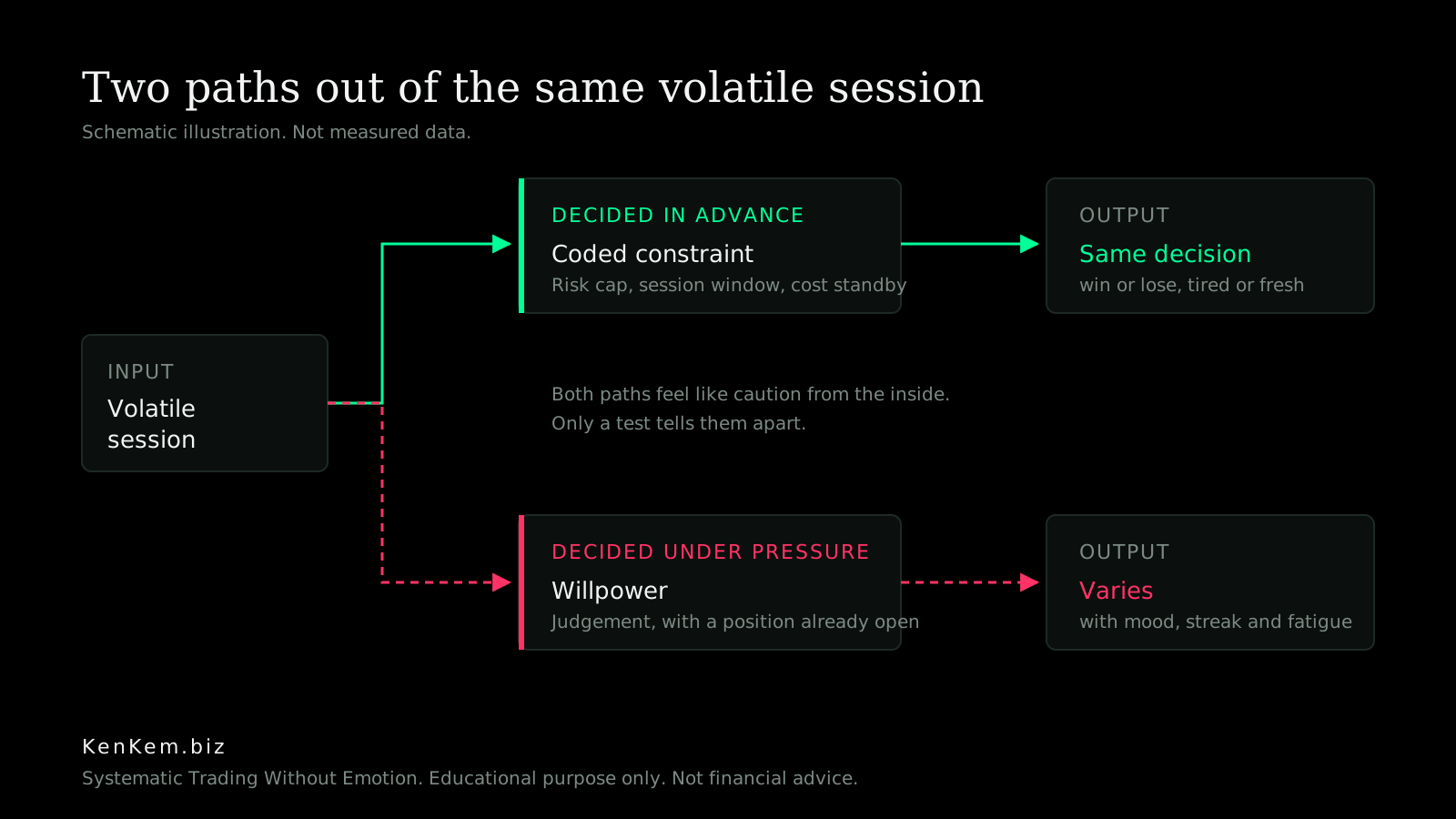
Why does emotion fill the space where rules are vague?
Because a vague rule still requires a decision, and the decision arrives exactly when I am least equipped to make it.
When the rules are clear, a volatile session meets a filter. When they are vague, it meets a feeling. That is not a character flaw specific to undisciplined people. It is what happens to anyone who has to arbitrate under time pressure with money on the line, which is why "just be more disciplined" has never worked as a plan for me. It asks the tired version of me to correct the mistakes of the rested version.
The cost is rarely dramatic. Emotional trading leaks in small repeated ways: entering slightly early, exiting slightly early, widening risk after a loss, paying spread on trades that were never worth taking. None of those look serious on a single trade. Across a year they are exactly the class of leak a written constraint removes without requiring willpower at all.
What does structure actually replace?
It replaces the argument, not the judgement.
The judgement still happens. It just happens once, at design time, when I have the research in front of me and no open position pulling at me. Risk caps, session windows and volatility filters are part of the strategy in my work, not an afterthought bolted on. Once they are written, there is nothing to negotiate with during the session, because the system either has a valid condition or it does not.
This is the part that sounds like a loss of freedom to someone still trading by hand. In practice it moves the decision to the point where I am reliable and takes it away from the point where I am not.
Why does a constraint have to be measured rather than felt?
Because the constraints that feel safest are the ones most likely to be wrong, and I have a set of rejections that say so.
The intuitive protections are obvious enough to write down in a sentence each: stop trading for the day after a bad enough loss, halt the system when drawdown gets deep, take profit sooner so gains cannot evaporate. I pre-registered and tested all three against my gold configuration. All three were rejected. The lower profit target was the eighth time a "bank earlier" idea has been falsified in my research, and that one made drawdown worse rather than better.
That result matters more to me than any of the wins, because from the inside those three rules are indistinguishable from the ones that worked. Both feel like caution. Both feel responsible. Only the test tells them apart, and my intuition was on the wrong side of it eight times in a row on one idea alone.
Which constraints survived the test?
Two, and their effect was on the risk axis rather than the return axis.
The first stands the system aside on days whose measured spread against prevailing volatility makes trading too expensive. The second reduces position size while equity is meaningfully below its prior peak. Tested together on a deliberately hostile window running from early 2024 to mid 2026, they moved maximum drawdown from about 56.7 percent to about 22.2 percent and profit factor from 1.253 to 1.333. Every half year in the test improved or held, and the worst half year improved substantially. These are backtest and MetaTrader 5 confirmation figures, not a live track record.
A third survivor came from a real loss rather than a hypothesis. A weekend gap cost me 3.72R on a live prop account, so I tested flattening before the weekend rather than resolving to watch it more carefully. Weekend held trades dropped from thirty to one, and all five half year folds improved. The lesson I took was not that I should be more vigilant on Fridays. It was that vigilance was the wrong instrument for a structural risk.
Why is leaving the system alone also a form of structure?
Because the urge to keep improving a working system is the same urge as the urge to intervene in a working trade.
I test that one directly. A fixed configuration held across every fold beat re-optimizing the parameters per fold, with five of five folds positive against four of five for the version that kept adapting. In a separate out of sample fold the profit factor came in at 1.327 against 1.203 in training, which is the opposite of what a curve fit looks like. Restraint measured better than responsiveness.
There is a tension I hold here on purpose. I am slow to lock a configuration, because locking is a commitment and a premature one freezes an idea before out of sample, cost and regime testing have had their say. Once it is locked, though, I leave it alone. Patience before the lock, stillness after it.
How do I keep my own ego out of the decision?
By deciding in advance which evidence gets the deciding vote, then not being the one who counts it.
Every idea passes the same short checklist: what is the edge, what is the cost, where is the invalidation, how good is the sample, which regime is this. Those five questions cut through noise faster than any amount of chart staring, mostly because none of them can be answered by how I feel about the idea.
Above the checklist sits the overfitting gate. Deflated Sharpe on the certified configuration reads 1.000 against a 0.95 bar, fed the true search context of thirty six configurations rather than a flattering count of one. The minimum track record length for that result is 192 trades and the sample is 1,423. The point of computing those is not that they are good numbers. It is that they were specified before I knew the answer, so a bad result would have been binding.
Except a hostile outside review of my process caught me leaning on the wrong one of those, and the correction belongs here rather than in a footnote. At the trial dispersion I recorded, that deflation gate is arithmetically incapable of failing: it would take something like ten to the fourteenth candidate configurations before the threshold could catch up with the strategy's own Sharpe. A gate that cannot fail was guarding the most important decision in the repo, which means the 1.000 was never the evidence I was treating it as. The test that does discriminate is the probability of backtest overfitting, and it came back above 0.5 in eight of nine cells across all three of my shipped configurations. That is the structural constraint working on me rather than for me, and it is the reason the plateau rule below is the thing actually keeping me honest.
Why does a rule need a mechanical reason behind it?
Because a correlation without a cause has no reason to keep holding, and I cannot tell the difference by looking.
Volume Profile is the base of my flagship for exactly this reason. It describes where an auction actually spent its time and volume, which is a market mechanism, not a pattern that happened to fit. That does not make it correct. It makes it falsifiable in a way a stumbled upon correlation is not.
The counterexample is in my notes too. I tested the Kaufman Efficiency Ratio as an entry filter, it produced no out of sample lift, and it is not part of the strategy. A plausible mechanism is a reason to test something, never a reason to keep it.
Where does my own structure still fall short?
In four places I would rather state than have someone find.
The expensive day standby is broker specific. Its threshold was derived on one feed, and on wider spread feeds it pins permanently on, which would silently muzzle the system, so it ships off by default there with its measurement left running as telemetry. A constraint against conditionality turned out to be conditional, which is humbling and correct.
My cost model still flatters me. Spread is charged on every trade, but slippage, latency and swap are not yet modeled, so live should be expected to be thinner than backtest. The concentration inside the strategy is real as well: the breakout mode carries about 96 percent of entries and nearly all of the net result, while the mean reversion leg has produced 51 trades, far below the 192 at which I would call anything significant.
The exit change that produced the improvements above reads a deflated Sharpe of 0.948 against a 0.95 bar on its own window once 588 trials are counted. That is a warning, not a pass. I treat it as an equal basis improvement rather than a certified result, and a forward demo is owed before I would call it anything more.
And there is no live track record. Everything above is research on roughly 160 million real broker ticks with byte for byte parity between my research engine and the shipped code, plus MetaTrader 5 confirmation runs. It is a hypothesis with evidence attached, not a result.
What is the honest takeaway?
Structure is not the same as caution, and that is the part most of the advice gets wrong.
Three cautious sounding rules failed my testing and two unglamorous ones survived it. If I had shipped on how each felt, I would have shipped the wrong three. The value of writing constraints down is not that written rules are wiser than intuition. It is that written rules can be tested, and an intuition cannot.
So the discipline I actually rely on is not the discipline to follow my rules in the moment. It is the discipline to let a rule I liked get rejected.
Frequently asked questions
Why is structure more effective than discipline in trading? Because structure resolves the decision once, at design time, while discipline requires resolving it again under pressure every session. A coded constraint behaves identically after a winning week and a losing one, which is precisely when human behaviour changes most. The practical effect is on the small repeated leaks, entering early, exiting early, widening risk after a loss, rather than on any single dramatic decision.
Do stop trading for the day rules actually work? In my own pre-registered testing, a daily loss cutoff was rejected, along with a hard drawdown halt and lower profit targets. That is a result on one gold configuration and not a universal claim, but it was enough to stop me trusting the category on intuition alone. The rules that feel most protective are the ones most worth testing before shipping.
Can reducing risk during a drawdown improve results? It did in my testing, unlike the harder rules that switch the system off entirely. Reducing size while equity sits meaningfully below its prior peak, combined with standing aside on measurably expensive days, moved maximum drawdown from about 56.7 percent to about 22.2 percent on a hostile 2024 to 2026 window. Those are backtest and confirmation run figures, not live results.
Should I keep optimizing a strategy that already works? My evidence says no. A fixed configuration held across all folds produced five of five positive folds, while re-optimizing per fold produced four of five. The instinct to keep improving a working system is closely related to the instinct to interfere with a working trade.
How do I know whether a filter in my system is real? Remove it and measure what happens. A filter that survives deletion testing is a measured edge lever, and one that does not is inherited habit wearing the costume of risk management. This is the only method I have found that does not rely on my own opinion of the filter.
What is a deflated Sharpe ratio and why does it matter? It adjusts a Sharpe ratio for how many configurations were searched before that result appeared, which is what makes it able to catch luck dressed as edge. My certified configuration reads 1.000 against a 0.95 bar with thirty six configurations counted honestly, and I no longer present that as proof of anything. An outside audit showed the gate cannot return a failing number at my recorded trial dispersion, so the pass carries no information. A more recent exit change reads 0.948 with 588 trials counted, which is a warning I report rather than round up, and it is the more useful of the two numbers precisely because it moved.
How much drawdown should a systematic trader plan for? The unflattering percentile rather than the average one. My own modeled distribution puts the median near 24 percent and the 95th percentile near 38 percent, and a hostile year confirmation run reached 74.2 percent. Planning around the median means planning to be surprised at the worst possible moment.
Does Master Volume Profile have a live track record? No, and I will not imply otherwise. Every figure here is a backtest or a MetaTrader 5 confirmation run on historical tick data, spread is modeled but slippage, latency and swap are not, and live results should be expected to be thinner than the research. Trading involves risk including the risk of loss.
Written by KenKem, a software engineer and founder of twenty years, learning quantitative trading in the open and publishing the process, rejections included.
This article was composed from the KenKem build-log series. Educational purpose only. Not financial advice. All figures cited are backtest or confirmation-run results, not a live track record. Past performance does not guarantee future results.