Why Do Traders Override Their Own Trading Systems?
· #trading-psychology #systematic-trading #trading-automation #risk-management #execution
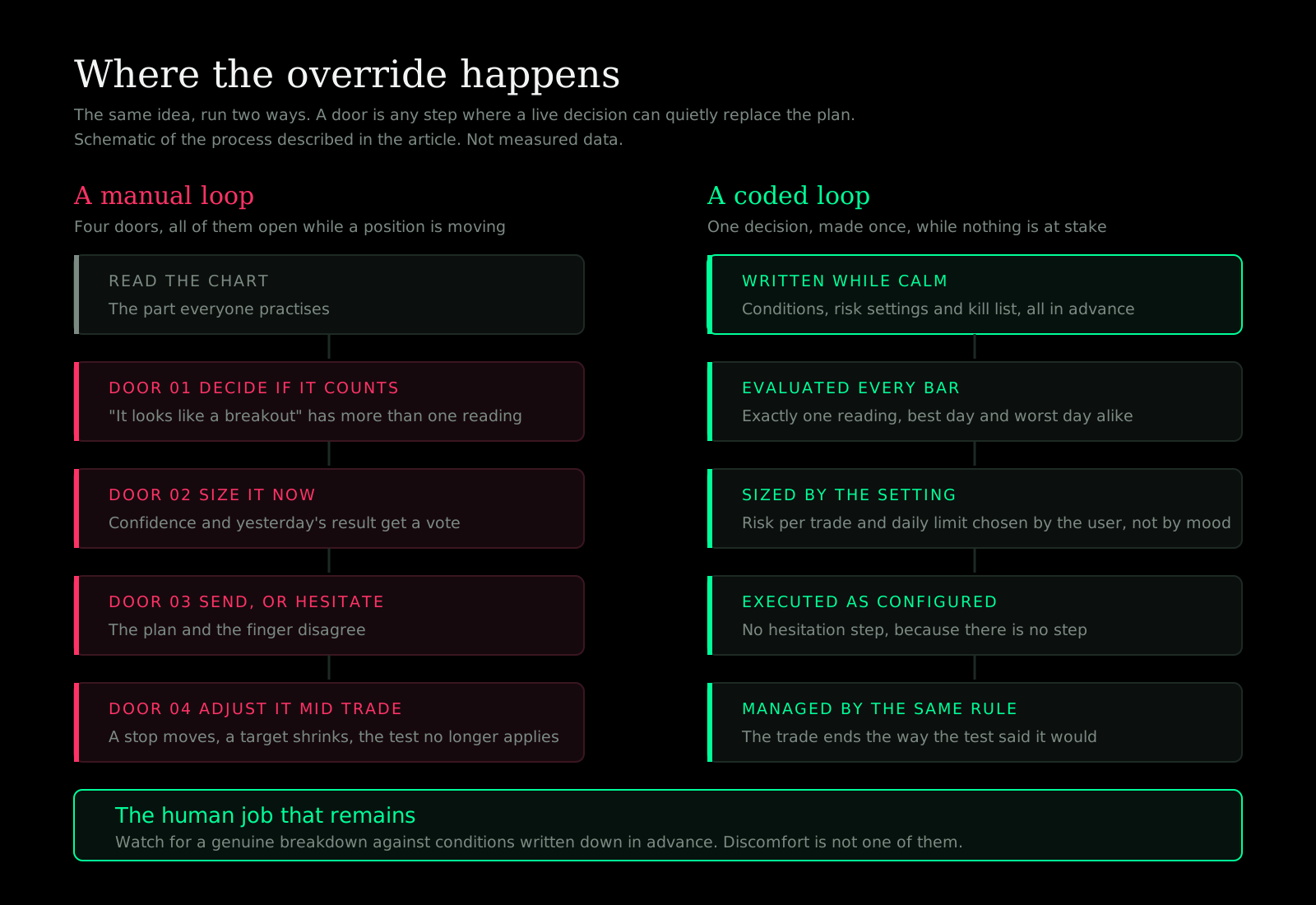
Because the rule was written by a calm person and the override is made by a frightened one, and nothing in a manual workflow keeps those two apart. Every step you leave between the decision and the order is a door that fear, hope or boredom can walk through. Automating execution is mostly the work of closing those doors.
As a self taught quant trader, this is the part of the problem I found hardest to admit. I did not lose money because my analysis was bad. I lost it because at the moment that mattered I did something other than what I had already decided to do, and then explained it to myself afterwards.
What actually counts as a rule a machine can follow?
One you can write down precisely enough that a program runs it the same way on your best day and your worst.
People argue about charts versus fundamentals, and I think that is the wrong dividing line. The real line is whether the rule survives being written out. "It looks like it is breaking out" is not a rule. Two people read that chart differently, and under pressure you will read it however your fear wants you to. "Enter when this condition holds and exit at that one" is a rule, because it has exactly one reading.
That is the bar every setup has to clear before it enters my research workflow. In the DQuants engine I developed, an idea only becomes a candidate feature once it is an explicit condition my code can evaluate identically on every bar. Anything I could describe in words but not encode stayed a note. Notes are fine. They are just not systems.
If you cannot encode it, you do not have a system yet. You have a hunch, and a hunch is exactly the thing you abandon at the worst possible moment.
Why does removing a manual step remove an emotion?
Because emotion needs somewhere to act, and a manual step is that somewhere.
The point of automating execution is not speed. It is that the code cannot get scared, cannot get greedy, and cannot decide that just this once the plan does not apply. A configured Expert Advisor reads the data, runs the settings its user chose, and sends the order. The decision was already made, calmly, when the rule was written. Live execution only carries it out.
This is where being specific about the tooling matters. The Master Volume Sniper on the MQL5 market is the Expert Advisor side, and it executes the rules a user configured for themselves, including their own risk per trade, daily risk limit, sessions and position caps. The Master Volume Profiler indicator, on TradingView and on MetaTrader 5, shows you the same read and leaves the order with you. Neither is a signal service, and neither removes the need to think. They differ in one thing only: how many manual steps sit between the read and the fill.
I am not automating greed or fear. I am removing the places where they get to operate.
Why is keeping your hands off harder than building the system?
Because building it is a project with an end, and not overriding it is a decision you have to make again every single day.
Here is the confession that even experienced quants make. The system runs itself for most of the session, and the strongest urge in the world is to watch the intraday number and intervene during a big swing. Manual overrides mostly make things worse, because the swing that frightens you into adjusting something is usually the ordinary noise your test already paid for.
I can put a figure on how ordinary. On a calendar month walk-forward of the gold strategy I have taken furthest, eleven of twelve months came out positive and the twelfth did not: August 2025 finished with a profit factor below one and a 21.6% loss. Those are backtest results on real broker ticks, not a live record. A losing month inside a validated system is not a malfunction. It is a scheduled event with an unknown date, and if I intervene every time one arrives I am not running the system I tested, I am running a different and untested one.
Building the system is step one. Not overriding it is where the actual emotional work happens.
How do you tell a genuine breakdown from ordinary discomfort?
By deciding in advance what a breakdown would look like, in writing, while you are calm.
There is a real difference between a system having a bad week and a system meeting conditions it was never built for, and the only way to tell them apart under pressure is to have defined them before the pressure arrived. My kill conditions are written down: a break of the drawdown ceiling, a profit factor that will not hold out of sample, a live curve that diverges from the tested one. None of those is "I feel uneasy about this position."
I know what the second category looks like because I have measured it. In 2024, on real MT5 fills, that same gold strategy lost 67.1% with a 74.2% drawdown. That was not noise and no amount of discipline would have saved it, because spread that year ran at roughly twice its usual share of what a trade could earn. The honest reading is that the edge has a habitat rather than a guarantee.
What fixed it was architecture, not willpower. Adding a rule that stands aside on measurably expensive days, plus automatic size reduction while the account sits below its own equity peak, took the worst peak-to-trough loss on that hostile window from 56.7% to 22.2%. I will describe what those mechanisms do. I will not publish the thresholds that arm them, because a threshold is the part someone can misconfigure. The general lesson holds anyway: when I found myself wanting to intervene by hand, the honest fix was to build fewer override buttons, not to try to want it less.
What does it look like to treat a strategy like production software?
Test it, stage it, monitor it in production, and keep a rollback path, because the bug here costs real money.
In software you do not ship to users and hope. You have a test suite, a staging environment, monitoring, and a way to back out. Trading deserves at least that much respect. The deploy gate, the parity check between the tested logic and the shipped one, and public live monitoring are not ceremony, they are ordinary engineering discipline pointed at a market.
That is also why the validation runs are as large as they are. The headline gold study covers 1,423 simulated trades on real Exness tick data, every tick rather than modelled bars. The minimum track record length statistic for that return distribution comes out at 192 trades, so the sample is roughly seven times what it needs to be before the result means anything. Both figures are backtest, and my cost model charges spread while slippage, latency and swap are not yet modelled, so I treat live as thinner than the test rather than richer.
It took me a long time to build the DQuants framework so this loop runs quickly, from hypothesis validation all the way to deployment. The speed matters less than the fact that every step leaves a record I cannot quietly edit later.
Why publish the account instead of the claim?
Because a visible curve is the last place an impulse has left to hide.
This whole project started because manual trading kept letting emotion win arguments against logic. Going public is the final containment of that bug. When the rules are visible and the equity path is live, there is nowhere for a quiet override to live unrecorded.
A live track record means very little over a week and starts to mean something over a year, so I am not building for the next post. I am building a curve I would still be willing to show in 2028, and I would rather earn one skeptic slowly than impress a believer quickly. If you have been burned by trading hype before, that scar tissue is exactly the right instrument to bring here.
And if the live account fails, I will say so, document why, and take the problem back to the engine. A process that cannot fail honestly cannot succeed honestly either. I am optimistic about the process and humble about the outcome, and I have made my peace with both.
Frequently asked questions
Why do traders override their own trading rules? Because the rule and the override are made by two different mental states, and a manual workflow does nothing to separate them. The rule gets written when nothing is at stake, and the override happens while a position is open and a number is moving. The fix is structural rather than motivational: remove the manual steps where an override is physically possible.
Does automating execution mean you stop thinking? No, it moves the thinking earlier. All the judgment goes into defining the conditions, choosing the risk settings, and deciding what would make you shut it off. What is left during the session is monitoring for a genuine breakdown, which is a much narrower job than second-guessing every trade. A trader who wants to stop thinking should not be automating anything.
How do you know a losing stretch is normal and not a broken system? By writing the kill conditions before the losing stretch starts. In my case that means a drawdown ceiling, an out-of-sample profit factor that will not hold, and divergence between the live curve and the tested one. For reference on scale, one month of the gold walk-forward finished below a profit factor of one with a 21.6% loss, which the test had already accounted for.
What makes a trading rule codeable? It has exactly one reading. If two competent people can look at the same chart and disagree about whether the rule fired, it is a description rather than a rule. The practical test I use is whether I can write it as a condition my code evaluates identically on every bar, and if I cannot, it stays a research note instead of becoming a feature.
Has the strategy you describe ever failed badly? Yes, and the worst case is documented. In 2024, on real MT5 fills, it lost 67.1% with a 74.2% drawdown, in a year when spread ran at roughly twice its normal share of what a trade could earn. That year is the reason the risk architecture exists, and adding an expensive-day standby plus drawdown-based size reduction cut the worst peak-to-trough loss on that window from 56.7% to 22.2%.
Is more willpower the answer to overtrading and overriding? It has never worked for me for long. Willpower is a resource that depletes exactly when volatility peaks, which is the worst possible correlation. Every guardrail I now rely on is coded, including session limits, daily risk limits and position caps, precisely because the version of me who would need to enforce them by hand is the version least able to.
Are these live trading results? No. Every figure here comes from backtests and validation runs on real broker tick data, not from a live track record. I run a live test and monitor it, and I will publish what it shows, but quoting research output as performance would be dishonest and I will not do it.
Which KenKem product does what? Master Volume Profiler is the indicator, available on TradingView and on MetaTrader 5. It shows the read and leaves the order with you, and it is not a signal service. Master Volume Sniper on the MQL5 market is the Expert Advisor side, and it executes only the rules and risk settings a user configures for themselves.
Written by KenKem, a software engineer and founder of twenty years, learning quantitative trading in the open and publishing the process, rejections included.
This article was composed from the automation and accountability posts of the KenKem build-log series. Educational purpose only. Not financial advice. Figures cited are backtest and validation results on real tick data, not a live track record. Past performance does not guarantee future results.