
ATR is the unit: why every distance in my systems is measured in volatility
· #atr #volatility #risk-management #systematic-trading
A fixed stop is two different trading decisions depending on the clock. I learned that the expensive way, as a manual trader, with stop distances that felt right in one session and were useless in the next.
Part 4 of 15: From discretionary to systematic
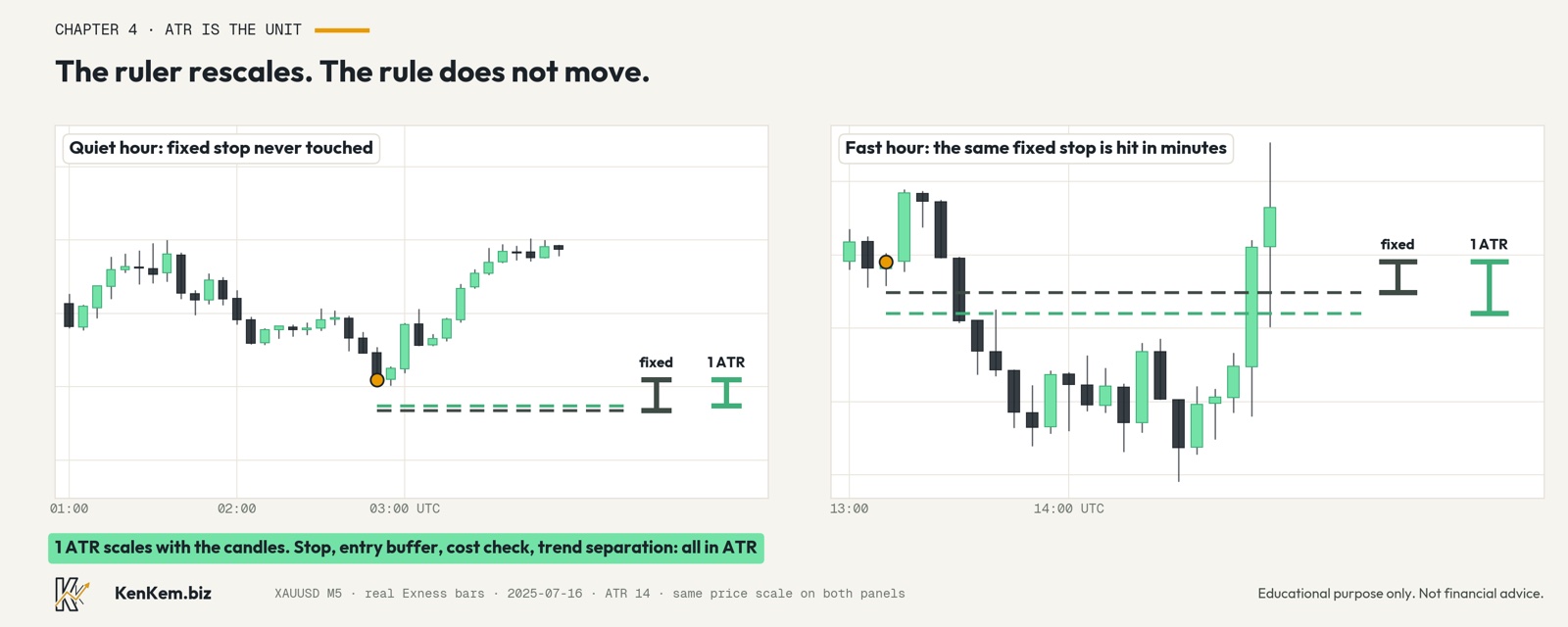
In a quiet Asian hour on gold, a fixed stop can sit far outside the normal movement and almost never get touched. Put the exact same distance on a trade during a busy New York open and it sits inside ordinary noise, so it gets hit by movement that means nothing. Same ticket, same rule on paper, two different strategies, chosen by the time of day.
This chapter is about the fix that changed how I build everything: stop measuring distances in points or pips, and measure them in volatility. The unit I use is ATR.
What ATR actually is
True range for a bar is the largest of three distances: the bar's high minus its low, the high minus the previous close, and the previous close minus the low. The last two catch gaps, where price jumped between bars without trading through the space.
ATR, average true range, is a smoothed average of that over recent bars. The classic setting from Welles Wilder is 14 bars, and it is what my open-source CBC Flip script uses internally for its optional range filter. Nothing about ATR predicts direction. It answers one question only: how far does this market normally move per bar, right now?
Why a unit changes everything
When a distance is written in ATR, the rule rescales with the market instead of fighting it. A stop of one ATR is a wide stop in a fast hour and a narrow one in a quiet hour, and in both cases it means the same thing: "about one bar of normal movement against me". The measuring stick changes. The rule does not.
That is the specific meaning of "adaptive" in my work. It does not mean the system learns, re-optimises itself or changes its mind about strategy. It means nearly every condition it reads is expressed relative to the market's own recent volatility, so one frozen configuration keeps meaning the same thing across quiet sessions, violent ones and different years. A frozen configuration is the only kind whose backtest means anything, which is why this matters so much.
Four places I use it
Stops. In my MasterVP Expert Advisor every position carries a hard stop sized from ATR. The exact multiple stays inside the EA, but the principle is the whole point: the stop is wide when the market is wide.
Entry buffers. A breakout in my method has to clear the edge of value by more than about half an ATR on a closed bar. A fixed buffer would be enormous in a quiet hour and meaningless in a fast one. Chapter 7 is entirely about this.
Costs. Spread is a toll paid on every trade, and what a trade can earn is bounded by how far the market is moving. So the affordability check compares spread to ATR, and when the toll is too large a share of the movement, the faster of my two systems stands aside. The effect is big: that five-minute leg took 89 trades across 2021-2023 and 1,643 across 2024-2026. When I tightened that filter it came out better in 6 of 11 half-years and worse in none.
Trend backdrop. Two moving averages can be correctly ordered and sitting on top of each other, or correctly ordered and cleanly apart. Dividing their gap by ATR makes the reading portable across sessions and instruments, and it collapses in chop, exactly when a crossover starts to flicker. Chapter 8 covers this.
An open-source example you can read
My free Daily Volatility Breakout script on TradingView uses the same idea with a daily range instead of ATR. At a fixed UTC anchor it measures the high-to-low range of the prior 24 hours, then places the long trigger at the anchor open plus 0.5 times that range and the short trigger at the open minus 0.5 times it. The reference stop is also 0.5 times the range. So on a violent day every distance widens, and on a quiet day every distance tightens, in proportion. The published description says it plainly: the risk unit widens on volatile days and tightens on quiet ones.
What it costs
ATR is an average of the past. After a news spike it is inflated for a while, so stops come out wider than the next hour needs. Before a sudden expansion it is too small. That lag is real and I dont pretend otherwise.
ATR also shrinks to almost nothing in a dead market, which is a reason to stand aside rather than a reason to trade tighter. The 10-minute system has a volatility floor for that: no entries while ATR is too small a share of price. More broadly, my system mostly stands aside on days when gold's daily range is below roughly 20 dollars, because the measured result per trade rises with the daily range. A unit tells you how big the market is. It doesnt make a small market worth trading.
The piece that makes it work: size
There is one consequence beginners miss. If the stop is wider in a fast hour, the position has to be smaller, or the money at risk changes with the clock and the whole idea collapses. The rule is: position size equals the money I am willing to risk divided by the stop distance. Wider stop, smaller size, same risk. Chapter 9 builds on this to define 1R.
The takeaway
If a number in your trading plan is written in points, pips or dollars, ask whether it should mean the same thing at 3 a.m. and at the New York open. If it should, write it in ATR.
What is one distance in your own plan that is still fixed, and does it hold up in both a quiet hour and a fast one?
From discretionary to systematic, part 4 of 15.
Previous: From a pattern you see to a rule you can test: the CBC Flip, step by step
Next: MasterVP 1/10: the map. Volume profile, mVAH, mPOC, mVAL, and why value matters
Part 4 of the From discretionary to systematic series, also published as an X Article. Educational purpose only. Not financial advice. Figures cited are backtest and research results unless stated as live, and past performance does not guarantee future results. Every trader remains responsible for their own risk settings and decisions.