
MasterVP 1/10: the map. Volume profile, mVAH, mPOC, mVAL, and why value matters
· #volume-profile #mastervp #market-auction
A candlestick chart tells you when things happened. A volume profile tells you where they mattered. Once I understood that difference, I stopped reading gold as a line on a screen and started reading it as an auction.
MasterVP · Systematic Trading Journey
Part 5 of 15: From discretionary to systematic
This is the first of ten chapters on MasterVP, the intraday method I built for gold. Before any setup, entry or exit makes sense, the map has to. So this chapter is only about the map.
The market is an auction
Price moves to advertise. Activity decides whether the advertisement was accepted. When price trades at a level for a long time, buyers and sellers are agreeing that the price is fair. When price races through a level and barely trades there, the market is rejecting it.
A volume profile turns that idea into a picture. Take a stretch of trading, split the price range into horizontal bins, and add up how much activity happened in each bin. Turn it sideways and you get a histogram on the price axis instead of the time axis.
The three lines
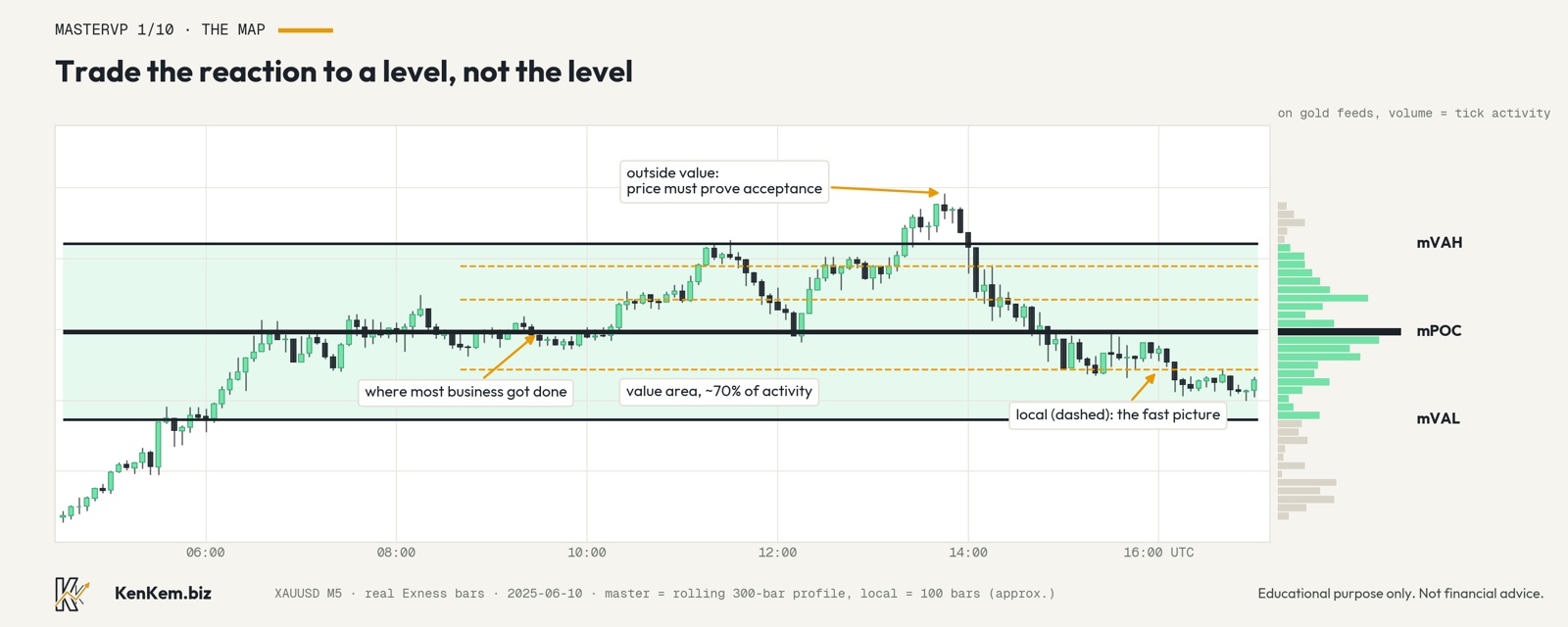
POC, the point of control, is the single price bin with the most activity. It is where the most business got done, which is why price keeps returning to it. That is also exactly why it is not a target. It is a magnet with no schedule.
The value area is the band around the POC holding the bulk of the activity. By the usual market-profile convention, about 70 percent. VAH is its top edge, VAL its bottom edge. Price spends most of its life inside value and behaves differently outside it.
Inside the profile you also see shelves and gaps. A high-volume node is a shelf where a lot of agreement happened, so price tends to slow down there. A low-volume node is a gap the market moved through quickly, so price tends to travel through it fast again, because there is little there to trade against.
Acceptance versus rejection
Price leaving the value area is not, by itself, a breakout. Price leaving value and staying there while activity builds is acceptance. Price poking out and being sold straight back inside is rejection, and rejection is often the better trade in the other direction.
The most useful sentence in this whole vocabulary: you trade the reaction to a level, not the level.
Two clocks: master and local
Here is where most retail volume-profile use goes wrong, in my experience. A level only means something relative to a horizon.
The master profile, mPOC, mVAH and mVAL, is the wide, slow structure: the shelves and ceilings that mattered across a meaningful stretch of trading. The local profile is the recent, fast picture, the context for right now. A break of a local edge while price is still inside master value is mostly noise. A break of the master edge, with the local picture already leaning the same way, is an event.
Collapse the two clocks into one and the levels seem to "stop working". They didnt. They were being read on the wrong horizon.
The honest caveat about "volume"
On spot gold and most CFD feeds there is no real traded volume. The tick files carry bid and ask; last price and volume are zero. What platforms call volume is the tick count, how many price updates arrived. So MasterVP builds its profile from per-bar tick activity, never from broker volume. Tick activity tracks real activity well enough to be useful, and I use it. But anyone selling "institutional order flow" on a retail gold feed is selling a proxy and calling it the thing.
Why my own profile and not the textbook one
Volume profile is public knowledge and worth learning whoever you buy from. MasterVP is my own idea, the intraday method I built on top of it. I had to prove that difference mattered, so in September 2026 I wired the standard session volume profile (a developing broker-day profile, 24 rows, 70 percent value area) into the same system as a drop-in replacement for both of my profiles. I tested them head to head across 1,002 paired configurations, with the pass rule written before the run.
Out of sample, the textbook session profile beat mine in fewer than one configuration in ten on the 5-minute clock, and fewer than one in fifty on the 10-minute clock. MasterVP also won the 2021-2023 holdout on both clocks. The session profile still ships, as an input that is off by default, so anyone can compare for themselves.
How the exact profile is constructed, how wide the windows are and how the levels are weighted stays inside the Expert Advisor. That is the part that took years.
Two ways to use the map
MasterVP comes in two forms. The TradingView indicator draws the master and local levels and shows the read, and leaves the order with you. The MT5 Expert Advisor executes the rules on the settings you configure, including your risk limits. Same map, two doors.
The limits
A profile describes the past. Levels move as the window rolls forward. Price can blow through a perfect shelf on news and never look back. The map tells you where agreement happened. It does not tell you what happens next, and nothing in the next nine chapters pretends otherwise.
The takeaway
Before you ask "long or short?", ask "is price inside value or outside it, and on which clock?" That one question removes a surprising number of bad trades.
When you look at a gold chart, which do you trust more, the master structure or the local one, and why?
From discretionary to systematic, part 5 of 15.
Previous: ATR is the unit: why every distance in my systems is measured in volatility
Next: MasterVP 2/10: the four setups. Breakout beyond value, reversion back to mPOC
Part 5 of the From discretionary to systematic series, also published as an X Article. Educational purpose only. Not financial advice. Figures cited are backtest and research results unless stated as live, and past performance does not guarantee future results. Every trader remains responsible for their own risk settings and decisions.