Trading is a business: a proven system plus consistent execution
· #systematic-trading #trading-business #risk-management
Most people I meet call trading a game. I stopped using that word the day I started keeping books on my trading the way I keep books on my software company.
Part 1 of 15: From discretionary to systematic
A game is played for the thrill of the next hand. A business is judged on its accounts over years. That one change of frame decided almost everything about how I trade now, and it is the right place to start this book, because every chapter after this one is really about one of two parts.
The business model
After a few years of trying to build something that works, I ended up with a very short formula. In my humble opinion a trading business needs exactly two things.
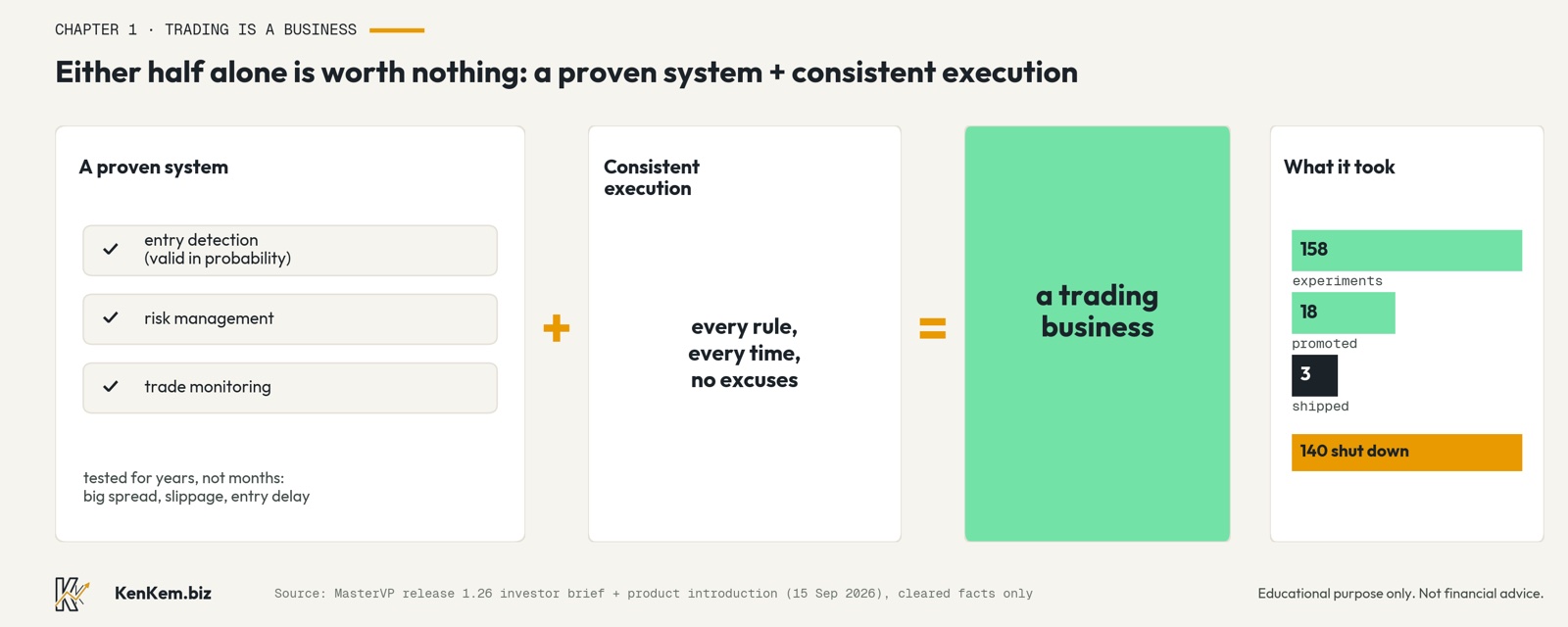
One: a proven trading system.
Two: consistent execution.
Neither half is optional and neither half rescues the other. A brilliant system run inconsistently is not a system. A disciplined trader running rules that never had an edge is just losing on schedule.
What "proven" has to mean
A trading system is a set of rules that fit together: a way of detecting entries that is valid in probability, risk management, and the monitoring of a trade once it is open. Together they have to make money over a long enough period, and long enough means years, not months.
"Proven" needs a definition or it means nothing. Mine is simple: tested in the conditions that hurt. Big spread. Slippage. Entries that arrive late. A rule that only works with perfect fills works in a spreadsheet and nowhere else.
That bar is expensive, and the cost shows up as rejection. In my quant development process I registered 158 experiments, each with its pass mark written down before the result was known. 140 of them never became a product. 18 were promoted. 3 shipped.
I think of those 140 the way a founder thinks about the ventures he shut down. Time and money spent to learn that something does not work, written off cleanly, and not reopened because I happened to like the idea.
Losing is an operating cost
Every real business budgets for things that fail. Rent gets paid in bad months. Products get discontinued. Nobody calls the owner a failure for it.
Trading losses work the same way, with one distinction that matters more than anything else in this book. A loss inside the rules is the cost of running the business. A stop that gets hit on a valid setup is rent.
The problem is the loss outside the rules: the trade taken because the last one hurt, the stop moved because price was "about to turn", the size doubled to win it back. Those arent operating costs. They are the business being run by someone else, usually by whatever I was feeling at the time.
This changes what a bad day means. If I followed every rule and lost, the day was an expense. If I broke a rule and won, the day was a liability that has not been billed yet.
Execution is the half that hurts
Consistent execution means running every rule like a robot, without excuses. If I skip a rule whenever I dont feel like following it, I dont have a trading system at all. I have a list of suggestions.
For a human this is always the painful half, and it hurts most at the start, exactly when the account is small and every loss feels personal. I still remember the first time I moved a stop. The rule was fine. I was the part that broke.
That is the real reason I hand execution to software. Not because the math is clever. Because I am human. The MasterVP Expert Advisor on MT5 executes the rules I configured, risk limits included, and I check on it once in a while rather than every day. The rules were decided in daylight, with evidence, so there is nothing left to decide at three in the morning with money on the screen.
What the books look like
Running trading as a business also changes which numbers I look at. Not the best trade: the worst drawdown. Not this week: the sample.
For my own system the questions are business questions. How deep was the worst drawdown in testing? 11.2% on the shipped book. What was the worst half-year? A 1.5% loss. How many trades sit behind the result, and what happens when costs get worse? Those numbers tell me whether the business survives a bad quarter. A winning screenshot tells me nothing about that, which is why I dont post them.
Who this book is for
I used to teach computer science, and I could package all of this as a paid course. I havent, for one honest reason. Without a real commitment to run trading as a business, or at least as a full-time job, a course mostly teaches people to blame the teacher when the losing part arrives.
So this book is the other option. Free chapters, the method shown in the open, and the tools I published so anyone can read the code. The path runs from discretionary trading, where you are both the system and the person executing it, to systematic trading, where the system is written down, tested hard, and then run by something more consistent than a tired human.
The takeaway
Before I touch an entry rule now, I ask which half of the business is weak. Most traders I talk to have a decent eye and no written rules. A few have written rules and no way of following them on a bad day. Both are fixable, but not at the same time and not with the same tool.
So, an honest question for you: which half is missing in your trading right now, the system or the execution?
From discretionary to systematic, part 1 of 15.
Next: Same chart, different decisions: what emotion does to a discretionary trader
Part 1 of the From discretionary to systematic series, also published as an X Article. Educational purpose only. Not financial advice. Figures cited are backtest and research results unless stated as live, and past performance does not guarantee future results. Every trader remains responsible for their own risk settings and decisions.