Same chart, different decisions: what emotion does to a discretionary trader
· #trading-psychology #discretionary-trading #systematic-trading
The same setup can appear twice in one week on a gold chart and get two completely different decisions from the same trader. I know, because that trader was me, more often than I like to admit.
Part 2 of 15: From discretionary to systematic
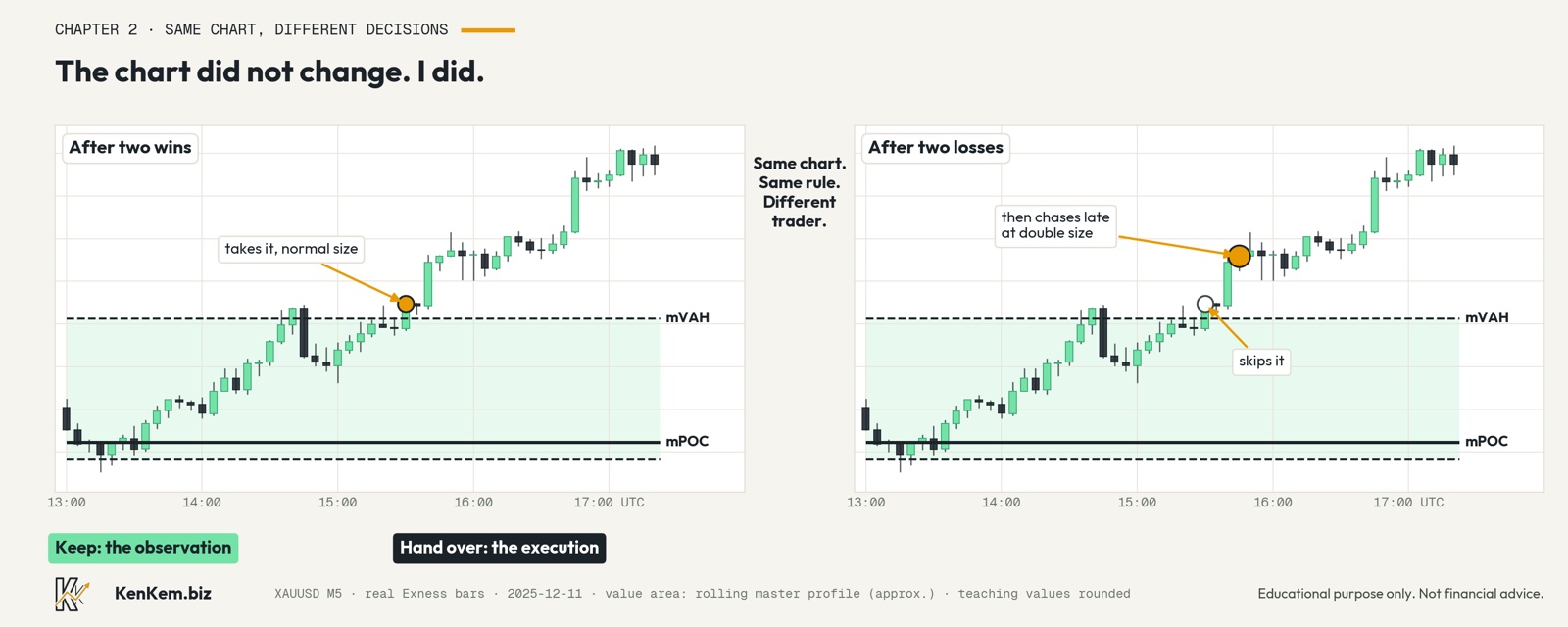
Here is the composite version from my manual-trading journal. On the Tuesday I had two winners behind me. Price closed above the edge of value, I took the trade at normal size, and I felt calm doing it. On the Thursday I had two losers behind me. The identical structure printed, and I hesitated. I watched it run without me, then bought it three candles later, higher, with double the size, to "make the week back".
The chart had not changed between Tuesday and Thursday. I had. That is the whole problem with discretionary trading in one sentence, and this chapter is about taking it apart honestly, including the parts of discretionary trading I still think are valuable.
The four ways a discretionary decision breaks
When I went back through my own journal from the manual years, almost every expensive mistake fell into one of four buckets.
Hesitation. After a few losses the next valid setup looks dangerous, so it gets skipped. The skipped trade is often the one that would have paid for the losses before it, because in most breakout-style methods a minority of trades carry the result.
Chasing. The skipped trade runs, and the fear switches from losing money to missing out. The entry comes late, at a worse price, with a stop that is now further away or squeezed too tight to make the numbers feel better.
Moving the stop. The stop was placed with a reason. Then price gets close to it and the reason is forgotten. A small planned loss becomes a large unplanned one.
Cutting winners early. This one feels like discipline, which is why it survives so long. Banking at 1:2 feels responsible every single time. When I finally tested it properly, more than twenty alternative exits, nine of them variants of taking partial profit early, every one cut the winners that pay for the losers. My eyes kept saying "take it". The math kept saying no.
Why it breaks: the input is wrong
None of these four is a knowledge problem. I knew where the stop belonged. I knew the setup was the same. The decision broke because its input was the state of the trader instead of the state of the market.
The last few results change how risky the next trade feels. A loss weighs more than a win of the same size. A move that is already running feels more certain than one that has not started. These are ordinary human wiring, well documented in behavioural finance, and no amount of chart study turns them off. Feeling FOMO is not optional. Letting it decide is.
So the useful question is not "how do I stop feeling this?" Its "how do I make the feeling irrelevant to what gets executed?"
What is worth keeping
This is where I disagree with the people who say discretionary trading is worthless. It isnt. The discretionary years gave me three things that no backtest could.
The eye. Hundreds of hours watching price around value-area edges taught me where to look. Every rule in my system started as something I noticed by hand.
The hypotheses. "Breakouts that close clearly beyond value behave differently from ones that only poke out" is a discretionary observation. It became a testable rule later, but the idea came from the chair, not from the computer.
The respect for cost. Paying spread and slippage with real money teaches you, fast, that a setup which works before costs is not an edge.
So the split I settled on is simple. The discretionary trader keeps the observation. The system takes over the execution.
The trap on the other side
One honest warning, because I walked into it. Once you start writing rules, the discretionary instinct comes back dressed as research: tweak the entry a little, nudge the exit, add one more filter. In my own research record, 77 studies that refined entries or exits produced 0 adoptions. The 13 studies about costs, venues and when to stand aside produced 4. My eye was good at finding where to look. It was bad at fine-tuning, because most fine-tuning is fitting yesterday's noise.
What I do now, in practice
When I still trade an idea by hand, the decision gets written before the order goes in: the setup, the stop, the target, and which rule says so. Afterwards I mark one thing only, whether I followed the rule. Not whether I made money. A losing trade that followed the rule is an expense. A winning trade that broke it is the dangerous one, because it teaches the wrong lesson with a reward attached.
After enough of those entries the pattern is obvious, and for me it was humbling: the setups were fine, the executor was inconsistent. That is the point where handing execution to software stopped feeling like a gadget and started feeling like the only honest fix. In the next chapter I show the first step of that handover, turning something you see on a chart into a rule a computer can check.
The takeaway
Same chart, different decisions, means the decision was never really about the chart. Keep the eye, keep the hypotheses, keep the respect for costs. Hand over the part that changes with your mood.
So here is my question: which of the four, hesitation, chasing, moving the stop or cutting winners, costs you the most?
From discretionary to systematic, part 2 of 15.
Previous: Trading is a business: a proven system plus consistent execution
Next: From a pattern you see to a rule you can test: the CBC Flip, step by step
Part 2 of the From discretionary to systematic series, also published as an X Article. Educational purpose only. Not financial advice. Figures cited are backtest and research results unless stated as live, and past performance does not guarantee future results. Every trader remains responsible for their own risk settings and decisions.