
MasterVP 8/10: blocked hours and drawdown protection, the rules that keep it alive
· #mastervp #risk-management #drawdown
The rules that decide when my system is not allowed to trade did more for its survival than any entry idea I ever had.
MasterVP · Systematic Trading Journey
Part 12 of 15: From discretionary to systematic
I came to systematic trading wanting a better entry. I stayed because of risk management. A system that survives a hostile month and earns modestly beats one that earns well until it no longer exists. So this chapter is the spine of MasterVP: the time rules and the drawdown guards, and the order in which they act.
Part 1: when it does not trade
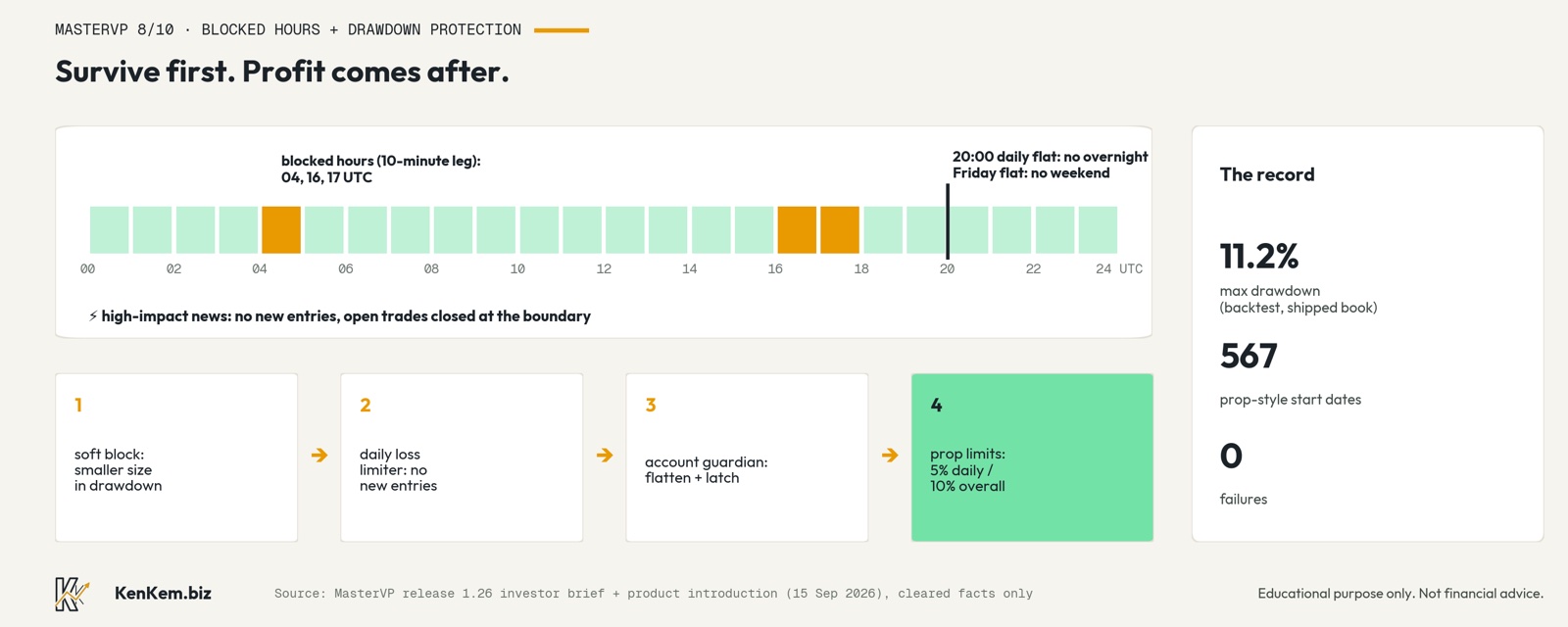
Daily flat at 20:00 UTC. Nothing is held overnight, so there is no exposure to the gap between one day's close and the next day's open.
Friday flat. Positions close before the weekend, at 20:00 UTC on the 5-minute leg and 20:30 UTC on the 10-minute leg. A weekend gap is a risk no stop can control, so the system does not carry one.
High-impact news. No new entries around scheduled high-impact events, and open positions are closed at the news boundary. Spread and slippage spike exactly when news hits, and a scalping system pays those costs on every trade.
Blocked hours. The 10-minute leg does not open trades in three specific hours: 04, 16 and 17 UTC. I re-tested that rule in September 2026 with the pass mark written first, because blocked hours are exactly the kind of rule that gets added once and never questioned. The 1,448 setups it refuses looked mildly positive when tested in isolation. Replayed in sequence, as the system would really have traded them, they came out at about zero, because taking them displaces other trades. So the block stays .
The habitat. MasterVP needs gold to move. The result per trade rises with gold's daily range, and on days below roughly 20 dollars of range the system mostly stands aside. Two filters keep it in that habitat: the faster leg stands aside when spread is too large a share of ATR, and the slower leg has a volatility floor. Quiet stretches are part of the design, they arent a malfunction.
Part 2: the guard ladder
Drawdown protection lives in a shared capital-protection library that every KenKem Expert Advisor uses, separate from the entry logic. It is ported one to one into my research engine, so its effect is measured, not assumed. The guards are ordered on purpose.
Step 1, the soft block. While the account sits below its own equity peak, new positions are taken at reduced size. Full size resumes on recovery. A losing streak digs a shallower hole.
Step 2, the daily loss limiter. Past a daily loss line, no new entries for the rest of the day.
Step 3, the account guardian. One circuit breaker across every KenKem EA on the account. If equity reaches the daily or overall line, it flattens everything and latches, whichever system caused it.
Alongside them sits an open-risk cap that adds up the live stop-loss exposure of every KenKem system and refuses an entry that would push the total past its limit.
The order matters. The soft block de-sizes before the limiter refuses, which acts before the guardian flattens. The EA prints its full ladder at start-up and warns if any two lines are mis-ordered. On a prop account the guardian line sits inside the firm's own limit, because the EA must stop opening before it is force-closed, and close before the firm does.
What it produced in testing
On the shipped two-system book, backtested on real ticks, the maximum drawdown was 11.2 percent and the worst half-year lost 1.5 percent. In my prop-firm stress test, 0.25 percent risk per trade inside a 5 percent daily and 10 percent overall limit, with at most 4 trades per session, I simulated 567 different start dates. Zero failed. The worst one reached an 8.3 percent drawdown against that 10 percent line.
What I rejected
Some protections sound safe and are not. Per-session loss caps and win-streak caps: 0 of 35 variants beat the control on both 10-minute legs. A "never give the day back" stop cut profit and worsened drawdown. A daily-loss cutoff can clip exactly the days that come before the recoveries. Each of those would have made the system feel safer and perform worse, which is the trap.
What it cannot do
These guards contain gaps, news shocks and violent markets. They cannot make a true black swan harmless, and nothing here says otherwise. At the shipped size, a 10 to 15 percent drawdown is an expected part of running it, not a sign it has broken. The guards decide how deep the hole can get. They dont stop holes from happening.
The one promise a system can make
In trading, never say never. But there is one thing I am comfortable saying about the EA: the limits are yours, and it follows them. Risk per trade, daily loss, overall drawdown and sessions are user settings, and the EA's job is to execute within them instead of negotiating with them, which is exactly what a human does at the worst moment.
The takeaway
Write your "do not trade" rules before your entry rules. When, how much, and how deep is too deep. If your plan only describes how to get in, it describes half a business.
Which of your losing days would a time rule or a drawdown ladder have prevented, and which would it have made worse?
From discretionary to systematic, part 12 of 15.
Previous: MasterVP 7/10: the exit. A far target around 4R, a trail, and why early exits lost
Next: MasterVP 9/10: consistency under stress. Spread, slippage, delay, two separate windows
Part 12 of the From discretionary to systematic series, also published as an X Article. Educational purpose only. Not financial advice. Figures cited are backtest and research results unless stated as live, and past performance does not guarantee future results. Every trader remains responsible for their own risk settings and decisions.