
MasterVP 7/10: the exit. A far target around 4R, a trail, and why early exits lost
· #mastervp #trade-management #exits
Every time I watch a trade sitting at 1:2 reward to risk, my eyes tell me to take it. The math has told me the opposite, every single time I have measured it.
MasterVP · Systematic Trading Journey
Part 11 of 15: From discretionary to systematic
This is the chapter where my own instinct and my own research disagree most clearly, so I want to show the evidence rather than just the conclusion.
The exit ladder
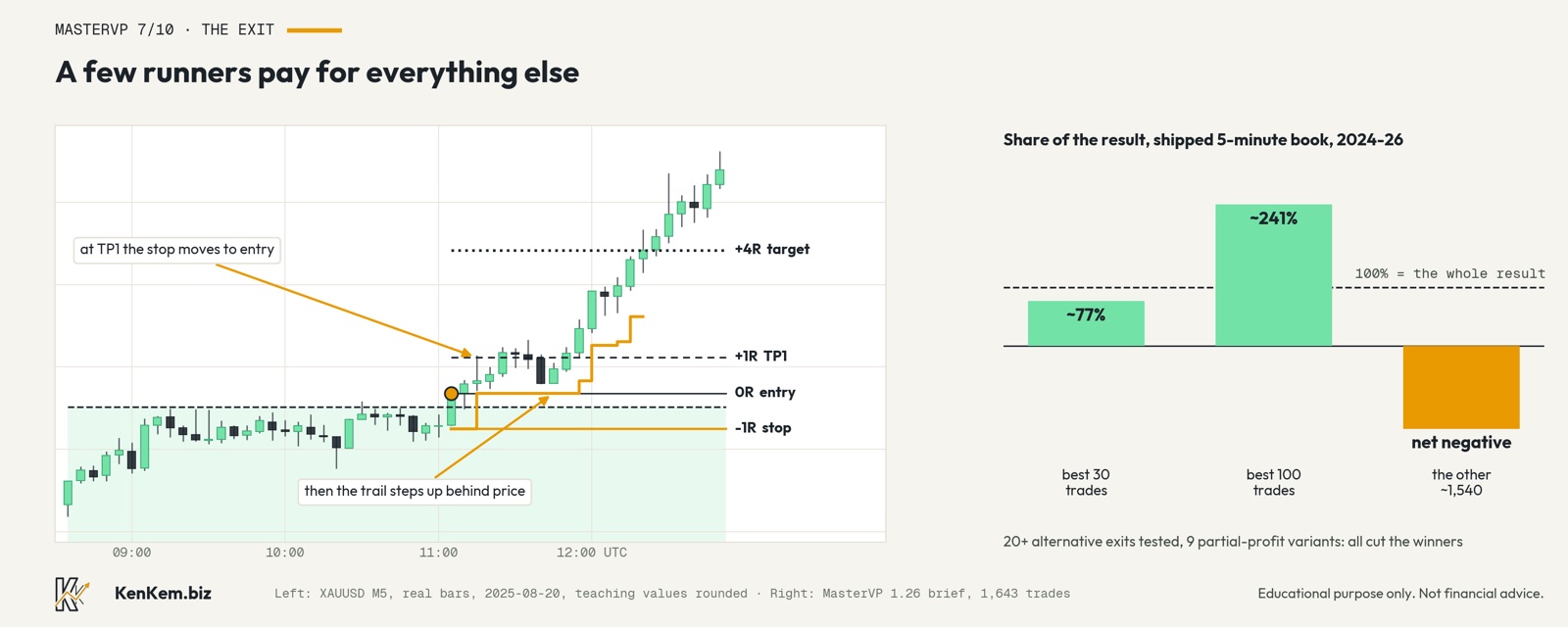
MasterVP exits in layers. The full stop caps each loss near 1R. At roughly 1R of progress, TP1, the stop latches to break-even (chapter 10). From there a progressive trail follows price toward a far final target, in the region of 4R. In practice the trail usually decides the exit; the far target is there for the trades that keep going. Session, news and daily-flat rules can also close a trade. The exact trail distances stay in the Expert Advisor.
Notice what is missing: there is no step where part of the position gets banked early.
What I tested against it
More than twenty alternative exits were tested against this ladder. Nine of them were partial-profit variants: close half here, a third there, pay yourself at 1:2. Several more were early exits of other kinds.
Every one of them cut the winners that pay for the losers.
I also tested the intuitive risk idea, "bank earlier to reduce risk", more than once over the life of this programme. Lowering the target made drawdown worse, not better. That still feels backwards to me when I watch a live trade, which is exactly why I trust the measurement over the feeling.
Why early exits lose: the shape of the result
The reason is concentration. A breakout system with a far target earns most of its money from a small number of trades. On the shipped 5-minute system, the best 30 of 1,643 trades account for about 77 percent of the result. The best 100 account for about 241 percent. Read that second number carefully: it means everything outside the best 100, roughly fifteen hundred trades, nets out negative. That long tail is the cost of being in position when the big move comes.
My investor brief puts it in one line: one target hit pays for about five full losses.
Now picture what a partial exit does to that shape. It trims every trade a little, including the rare runner that was going to pay for five losers. The small trades barely change. The big ones, the only ones that matter, get cut. You pay for the lottery ticket and then sell it back before the draw.
The cost of letting it run
This is not a free lunch and I wont pretend it is.
Most trades end at break-even or at the stop. Sitting in front of it, that means long stretches of scratches and small losses while waiting for a runner that may not come this week. It means watching trades go from plus 2R back to zero.
It also makes the statistics harder. Fat tails mean a large trade count carries less independent evidence than it looks: on the 5-minute stream, 1,643 trades carry the weight of about 512 independent observations. Every significance test in my documentation uses that smaller effective number, not the headline count.
And it means drawdowns can last. A system whose result depends on rare trades can go a while without one.
The honest split between human and machine
Here is where I have landed, and I think it is the most practical sentence in this chapter. By hand, I might still cap a trade at what I can actually sit through, because a human has to survive watching it, and a rule you cannot follow is not a rule. The Expert Advisor does not have that problem. So the EA gets the math, all of it.
That split is the whole argument for systematic trading in one example. The rule that maximises the result is not always the rule a human can execute. When those differ, the honest move is to hand that rule to something that can.
I even built a separate MT5 indicator just to draw what the EA did, trade by trade, so I could audit its exits by eye. Looking at it, the 1:2 exit still looks tempting on almost every chart. The distribution still says no.
The takeaway
If your exits are fixed at a modest reward, measure what happened to the trades after you left them. Not one or two memorable ones, all of them, in R. If a handful of runners would have paid for a long list of small losers, your exit is trimming the only trades that matter.
Do you bank at a fixed reward, or let a trail decide, and have you ever measured what your early exits cost you?
From discretionary to systematic, part 11 of 15.
Previous: MasterVP 6/10: break-even after TP1. Protecting a trade without strangling it
Next: MasterVP 8/10: blocked hours and drawdown protection, the rules that keep it alive
Part 11 of the From discretionary to systematic series, also published as an X Article. Educational purpose only. Not financial advice. Figures cited are backtest and research results unless stated as live, and past performance does not guarantee future results. Every trader remains responsible for their own risk settings and decisions.