
MasterVP 6/10: break-even after TP1. Protecting a trade without strangling it
· #mastervp #trade-management #risk-management
Moving a stop to break-even is the most emotionally satisfying thing a trader can do, and done at the wrong moment it is one of the most expensive. I did it for years by feel, usually too early.
MasterVP · Systematic Trading Journey
Part 10 of 15: From discretionary to systematic
This chapter is about how MasterVP handles it as a rule, and why the timing matters more than the idea.
The rule, rounded
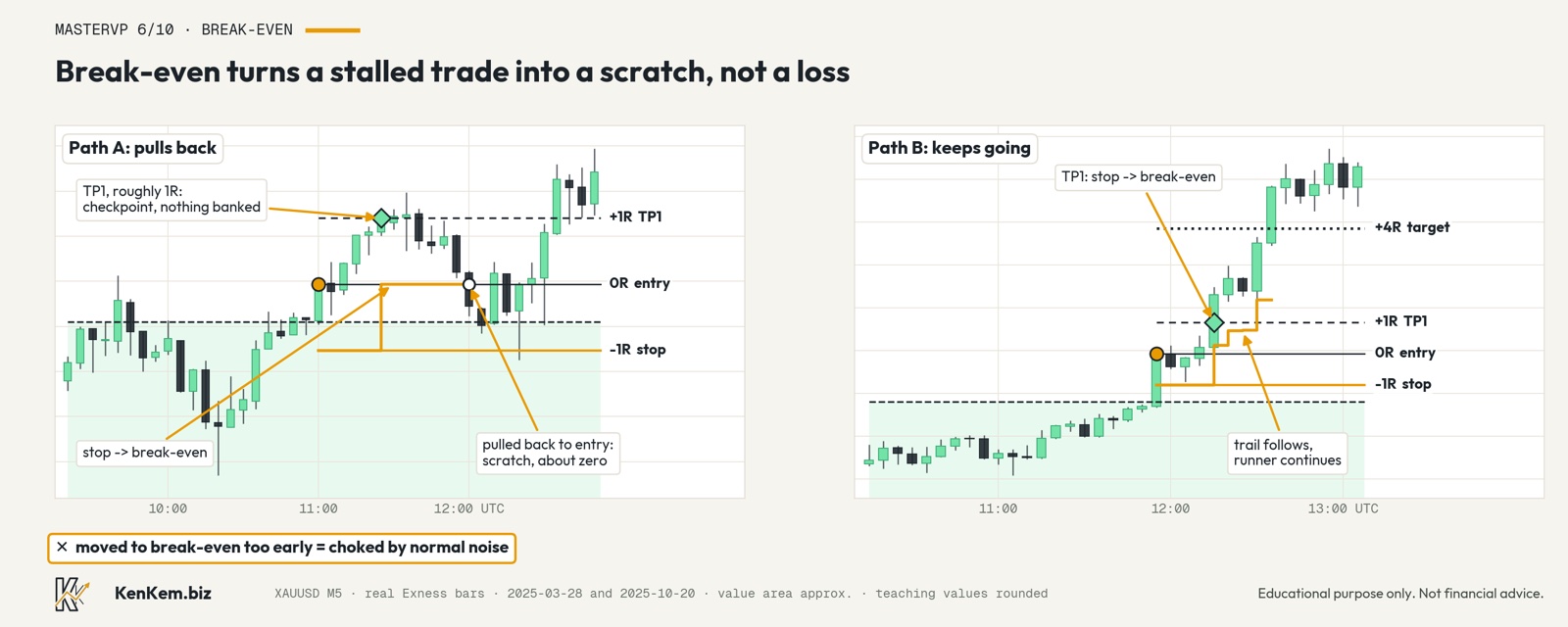
Once a trade has moved roughly 1R in my favour, a checkpoint I call TP1, the stop latches to break-even. From there a progressive trail follows price toward a far final target. The exact trigger and trail distances stay in the Expert Advisor. Roughly 1R is the honest teaching version.
One detail surprises people. At TP1 nothing gets banked. No partial close, no "pay yourself". TP1 is a checkpoint that changes the stop, not an exit. Chapter 11 explains why: every partial-profit variant I tested cut the winners that pay for the losers.
What break-even buys
Before TP1, the trade can lose a full 1R. After the latch, if the idea fails and price comes all the way back, the trade closes near zero. A loss becomes a scratch.
That matters because of the shape of a breakout system. Most breakouts dont become big moves. Many stall after a decent start. Without the latch, a good share of those stalls would drift back to the stop and become full losses. With it, they become scratches. The full stop still caps the trades that fail from the start, and the rare runner is left alone to pay for everything.
So break-even is not about feeling safe. It is about changing the distribution: fewer full losses from trades that were working, at the cost of some trades that would have recovered.
Why not sooner
This is where my manual habit was wrong. Moving the stop to entry after a small move feels responsible, but it places the stop inside the normal noise of the market. Ordinary back-and-forth then knocks the trade out at entry, and the move it was waiting for happens without it.
Measured in ATR, a stop that sits at entry right after a breakout is often less than one bar of normal movement away. That is not protection. It is a coin flip with a small cost attached. Waiting for roughly 1R of progress means the trade has shown real follow-through before its room is taken away.
Why not never
The opposite mistake is leaving the initial stop in place for the whole trade, on the theory that "the idea is either right or wrong". The problem is that ideas can be half right. Price breaks out, travels, stalls, and gives it all back. Without a latch that is a full loss on a trade that was correct for a while. The latch is the compromise: protect what the trade has proven, keep room for what it has not proven yet.
It is not free, and it is not risk-free
Two honest notes. Break-even is not exactly zero. Spread, commission on some accounts and slippage on the exit mean a "break-even" exit can still cost a little. And a stop at break-even reduces the remaining downside of that trade. It does not make trading free of risk, and gaps or violent news can still fill beyond any stop.
The cost that matters most is psychological, and it is why this is software in my case. A breakout system with a break-even latch produces long stretches of scratches and small stops while it waits for the runner. By hand, that feels like doing everything right and getting nothing. That is exactly when a human starts "improving" the rule.
What I tested instead, and rejected
The research record on trade management is a list of good-sounding ideas that lost.
A "never give the day back" stop, closing everything once the day's profit retraced, cut profit and made drawdown worse.
Managing open trades on a faster clock than the entry clock was worse on all three deployed legs.
Per-session loss caps and win-streak caps: 0 of 35 variants beat the control on both 10-minute legs.
Across my research, 77 studies that refined entries or exits produced 0 adoptions. The latch survived because it is a structural rule, not a fine-tune.
Time-based exits do the rest
Not every trade ends on a stop or a trail. Session, news and daily-flat rules can also close a position. Nothing is held past the New York close or over a weekend. Chapter 12 covers those.
The takeaway
The question to ask about break-even is not "should I move my stop?" It is "how much proof should the trade show before I take its room away?" Too little proof and you get choked by noise. No rule at all and you give back trades that were working.
When do you move your stop to break-even today, and is that a measured rule or a feeling?
From discretionary to systematic, part 10 of 15.
Previous: MasterVP 5/10: the stop, and what "1R" really means
Next: MasterVP 7/10: the exit. A far target around 4R, a trail, and why early exits lost
Part 10 of the From discretionary to systematic series, also published as an X Article. Educational purpose only. Not financial advice. Figures cited are backtest and research results unless stated as live, and past performance does not guarantee future results. Every trader remains responsible for their own risk settings and decisions.