
MasterVP 5/10: the stop, and what "1R" really means
· #mastervp #risk-management #position-sizing
If you take one concept from this book into your own trading, I would want it to be this one. R. Every result I publish about my system is written in it, and once it clicks, a lot of trading talk stops making sense.
MasterVP · Systematic Trading Journey
Part 9 of 15: From discretionary to systematic
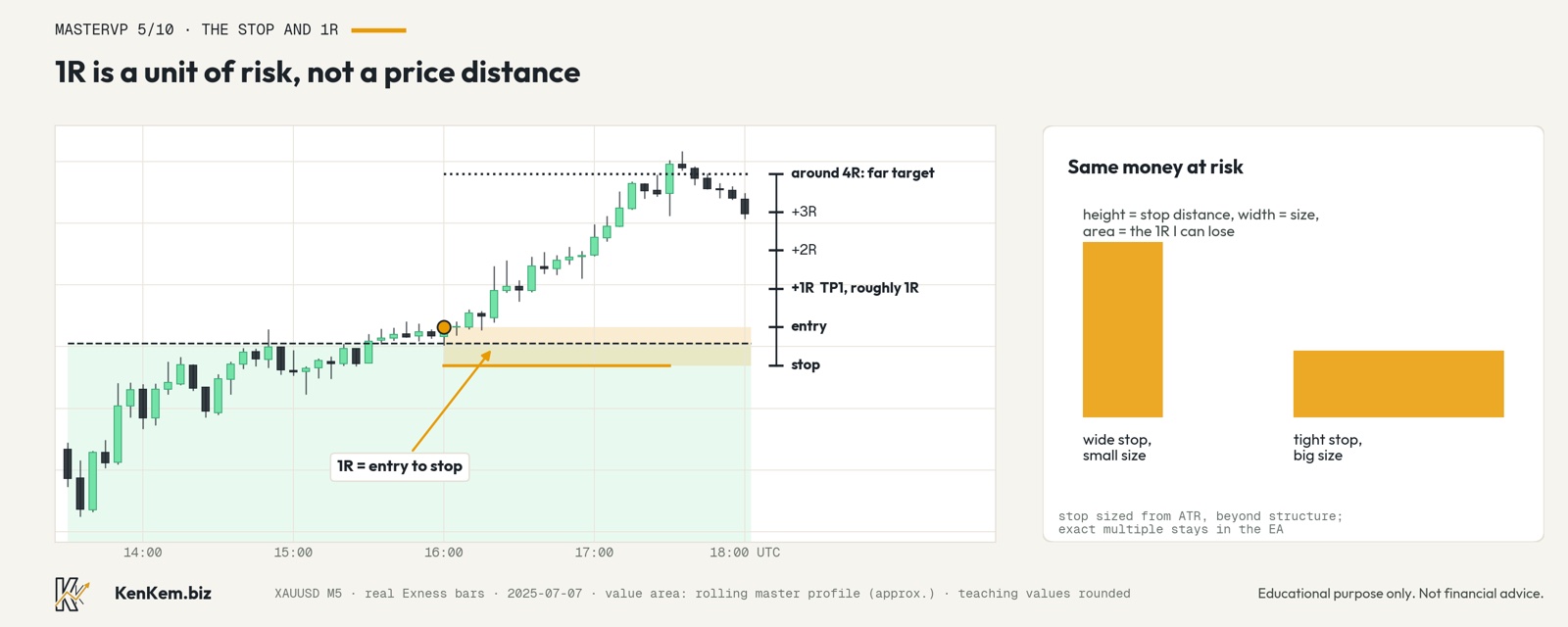
R is the amount you risk on a trade. One R is the distance from your entry to your stop, expressed as the money you lose if the stop is hit. A trade that hits its stop is roughly minus 1R. A trade that gains twice the stop distance is plus 2R. The formula in my product documentation is the plainest version: R equals the price move divided by the initial stop distance.
Why not just use money or points
Because money and points hide the thing that matters. A gain of a given number of points is excellent if the stop was small and poor if the stop was huge. A gain in dollars depends on position size, which depends on the account. Neither tells you whether the decision was good.
R strips all that away. It asks one question: for each unit of risk I took, what came back? Thats what makes trades comparable across quiet and fast days, across instruments, and across account sizes. It is also why my research results are in R. The random-entry test I describe in chapter 13 compares my rule against fake entries per trade in R, so a balance or a return never has to appear.
The stop comes first
In MasterVP every position carries a hard stop from the moment it opens. It is sized from ATR and placed beyond the structure the trade depends on, so that normal movement does not touch it but a real failure of the idea does. The exact multiple stays in the Expert Advisor, but the principle is chapter 4: the stop is wide when the market is wide.
Three rules about the stop that I treat as non-negotiable.
It exists before the entry. A trade without a stop has an undefined R, which means it has undefined risk.
It never moves further away. A stop can move toward safety, to break-even or along a trail. It never moves to give a losing trade more room. That single rule, followed without exception, removes the most destructive manual habit I know.
It is the constraint, not the target. The stop is what keeps the business alive. The target is negotiable. Chapter 11 shows why I treat it that way.
The sizing arithmetic
This is the part that makes R work in practice, and it is simple. Decide how much money one R is. Then the position size is that amount divided by the stop distance. If the stop has to be twice as wide today because the market is moving twice as fast, the position is half as big, and the money at risk is unchanged.
That is how a volatility-sized stop and a fixed risk per trade live together. The MasterVP risk manager does exactly this: lot size comes from the stop distance and the account risk the user configured. In my prop-firm simulations the setting was a quarter of a percent of the account per trade, inside a 5 percent daily and 10 percent overall loss limit.
What 1R lets you see
Once every trade is in R, the whole system becomes a distribution you can read. How often does it lose 1R? How often does it scratch near zero? How often does it reach a far target? How large is the average loss, and does it stay near 1R or drift beyond it because of slippage?
In MasterVP the full stop caps each loss near 1R, the break-even rule turns stalled trades into scratches, and the rare trade that runs to the far target pays for several losers at once. The concentration is strong: in my investor brief, one target hit pays for about five full losses. None of that can even be described without R.
What it costs
A hard stop will be hit by moves that later turn around. That is the price of a defined loss, and every stop-hunt complaint is really a complaint about that price. Id rather pay it in small, known pieces than once in a large, unknown one.
Slippage is real, so a stopped trade does not always cost exactly 1R. Measuring R on real fills rather than on chart prices is what tells you how far reality drifts from the plan.
And R does not tell you whether a strategy is good. It only makes the question answerable. A strategy that averages a small positive R per trade over a large sample after costs might be worth running. One that only looks good in points probably isnt.
The takeaway
Write your next ten trades in R, including the ones you did not take but should have. Two things usually become obvious: where your real losses come from, and whether your winners are big enough to pay for them.
Do you size your positions from the stop distance, or does the stop get placed after the size has already been decided?
From discretionary to systematic, part 9 of 15.
Previous: MasterVP 4/10: the trend veto. Two EMAs decide what not to take, never what to take
Next: MasterVP 6/10: break-even after TP1. Protecting a trade without strangling it
Part 9 of the From discretionary to systematic series, also published as an X Article. Educational purpose only. Not financial advice. Figures cited are backtest and research results unless stated as live, and past performance does not guarantee future results. Every trader remains responsible for their own risk settings and decisions.