
MasterVP 3/10: the entry. Why a breakout must clear value by about half an ATR
· #mastervp #atr #breakout-trading
The most expensive habit I had as a manual trader was buying the candle that had just touched the level. Not the one that broke it. The one that touched it.
MasterVP · Systematic Trading Journey
Part 7 of 15: From discretionary to systematic
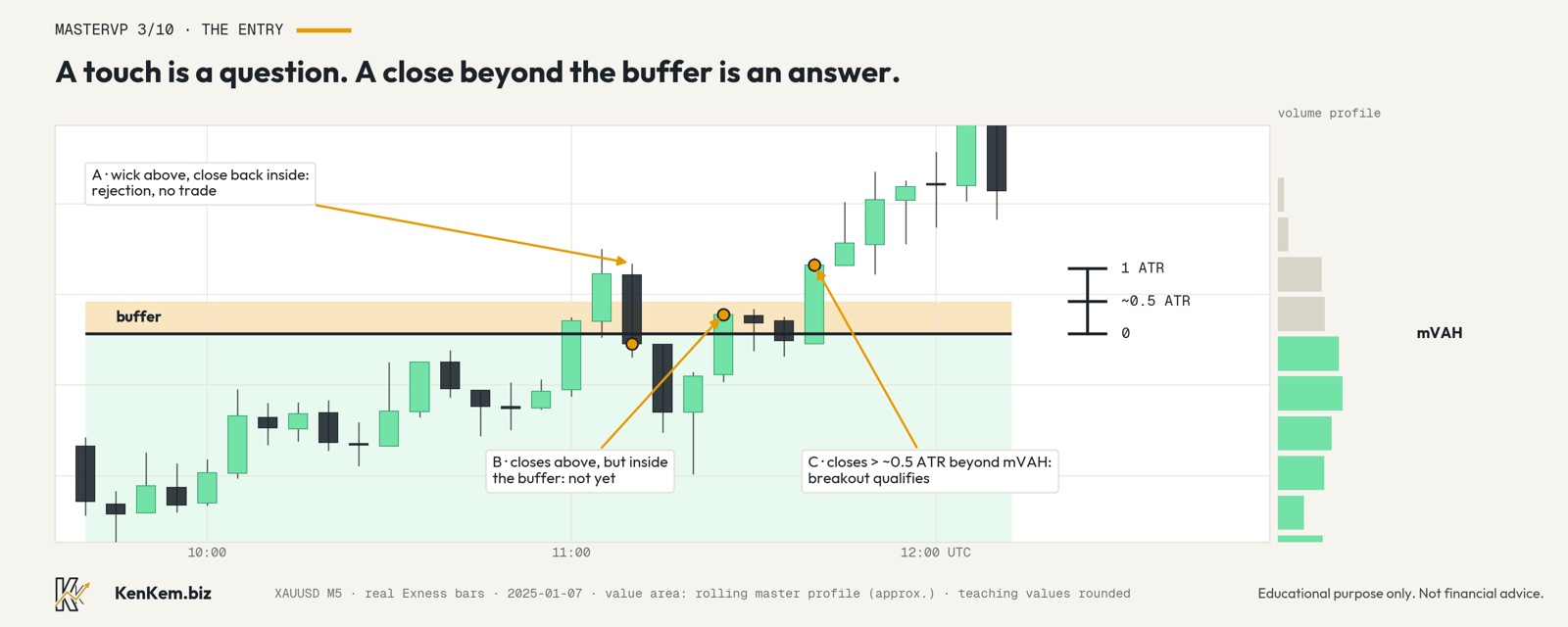
This chapter is about the single rule that removed that habit from my trading, and it is one of the simplest in the whole method: in MasterVP, a breakout only counts once a closed bar has cleared the edge of value by more than about half an ATR.
The problem with "it broke the level"
Draw a line at mVAH and watch any gold chart for a day. Price will cross that line many times. Wicks stab through it and snap back. Candles close a hair above it and the next one closes back inside. Each of those looks like a breakout for a moment, and each moment is when a discretionary trader feels the pull to buy.
Most of those crossings are the auction testing the edge, not leaving it. Chapter 5 called it rejection: price pokes out, fails to build activity, and gets pulled back inside. If I enter on the poke, I am buying exactly the moves that are most likely to fail.
So the rule needs to separate two events that look identical for a few seconds: a test of the edge and an escape from it.
The buffer
The answer is distance plus confirmation. The bar has to close, not just trade, beyond the edge. And the close has to sit more than about half an ATR beyond mVAH for a long, or below mVAL for a short.
Why a close: because a wick is information the market has already taken back. A close is the price the auction actually settled on for that bar.
Why distance: because a close one tick beyond the edge is still, statistically, a coin-flip around the line. Asking for real distance is asking for evidence that price is willing to trade away from value.
Why ATR and not points: because, as chapter 4 argued, half an ATR is a small move in a quiet hour and a large move in a fast one, and that is exactly right. The buffer scales with the noise it is trying to filter. A fixed buffer would be too strict at night and meaningless at the New York open.
What the buffer costs
Every filter costs something, and I would rather say it than have you find it.
The entry is later. By the time the bar closes beyond the buffer, part of the move has happened, so the entry price is worse than the bar that first touched the line.
Some real breakouts never give a qualifying close. They gap away or accelerate in a single bar and the system watches. That is a real missed opportunity, and I accept it, because the alternative is buying every poke.
The stop is placed from the entry, so a later entry means the trade starts closer to failure in price terms. That is one reason stops are sized from ATR too.
Why not demand even more distance
If half an ATR filters noise, wouldnt a full ATR filter more? This is where testing beat intuition. I tested the opposite kind of rule too: declining entries that are already far from where the move started, the classic "dont chase". It sounds wise. Inside my research it was tried in 4 formulations across 3 data feeds and passed 0 times. The best version failed the deflated Sharpe check at 0.92 against a 0.95 bar and depended on just 20 trades.
So the buffer is a floor, not a ceiling. It says "far enough to be a real escape", not "not too far". Once price has escaped with evidence, the far-away entries were not measurably worse.
The other half of an entry: runway
Distance from the edge is half of the entry. The other half is distance to the next obstacle. A breakout must have enough runway after costs before it reaches the next shelf of heavy activity. A clean close beyond the buffer that lands right under an old wall of agreement is not a trade I want.
Costs also decide the clock. Spread is a fixed toll per trade, while the edge grows roughly with the square root of the timeframe. On 1- and 3-minute charts the toll ate the edge in three separate falsification attempts. That is why MasterVP trades the 5- and 10-minute charts, and why no trade in the book lasts under five minutes.
What is not disclosed
The exact buffer value, how momentum and structure are scored, and how runway is measured stay in the Expert Advisor. "More than about half an ATR" is the honest rounded version, and it is enough to understand the logic and test the idea on your own chart.
Why this matters beyond MasterVP
This rule is really an anti-FOMO rule written as math. The urge to buy the touch is the urge not to miss the move. The buffer makes that urge irrelevant: the system cannot enter until the evidence is on the chart, however strongly I feel about it.
The takeaway
Whatever you trade, write down the difference between a test of your level and an escape from it. If the only difference is "it went through", the rule has not been written yet.
When a level breaks on your chart, what exactly has to happen before you call it a breakout?
From discretionary to systematic, part 7 of 15.
Previous: MasterVP 2/10: the four setups. Breakout beyond value, reversion back to mPOC
Next: MasterVP 4/10: the trend veto. Two EMAs decide what not to take, never what to take
Part 7 of the From discretionary to systematic series, also published as an X Article. Educational purpose only. Not financial advice. Figures cited are backtest and research results unless stated as live, and past performance does not guarantee future results. Every trader remains responsible for their own risk settings and decisions.