
MasterVP 4/10: the trend veto. Two EMAs decide what not to take, never what to take
· #mastervp #trend-filter #indicators
Nothing in my system enters a trade because a moving average crossed. Moving averages are in there, but they only have one power: they can say no.
MasterVP · Systematic Trading Journey
Part 8 of 15: From discretionary to systematic
That inversion, indicator as a brake and never as an accelerator, is most of what separates my method from the stack almost everyone starts with. I started with it too: two moving averages, a crossover, an oscillator to "confirm". This chapter explains why I moved them to the back seat, and how they still earn their place there.
The crossover problem
A crossover strategy uses an indicator as the trigger. When the fast average crosses the slow one, buy. The trouble is visible on any chart. In a trend the cross arrives late, after a large part of the move. In a range the averages braid around each other and fire signal after signal, each one a small loss.
The deeper problem is what an indicator is made of. A moving average is a function of past prices. It cant know anything price didnt already show. So when it "signals", it is restating the move in a smoother voice, slightly late.
What I measured
I wanted that to be a measurement rather than an opinion, so I ran an audit in the Dquants engine I built: more than two years of one-minute gold bars, the classic families (EMA distance, RSI, the DMI spread and ADX), tested against an ATR-normalised forward move.
Three findings changed how I use them. None of them led price: every one matched the move that had already happened. Several were close to the same reading wearing different names, RSI and the DMI spread especially, so "confluence" between them is one opinion counted twice. And none of them added out-of-sample predictive value on top of a baseline of price momentum, volatility and volume-profile structure, a baseline that deliberately contained no EMA, RSI or DMI at all.
The audit's own verdict was that these indicators are state variables, not alpha. They describe the backdrop. They do not find the trade. ADX was the interesting exception: it had almost no relationship with direction, so it is useful as a regime read and useless as a direction call.
So no classic indicator earned the right to be the sole reason a trade exists. That is exactly why, in my system, they are a veto.
How the veto works in MasterVP
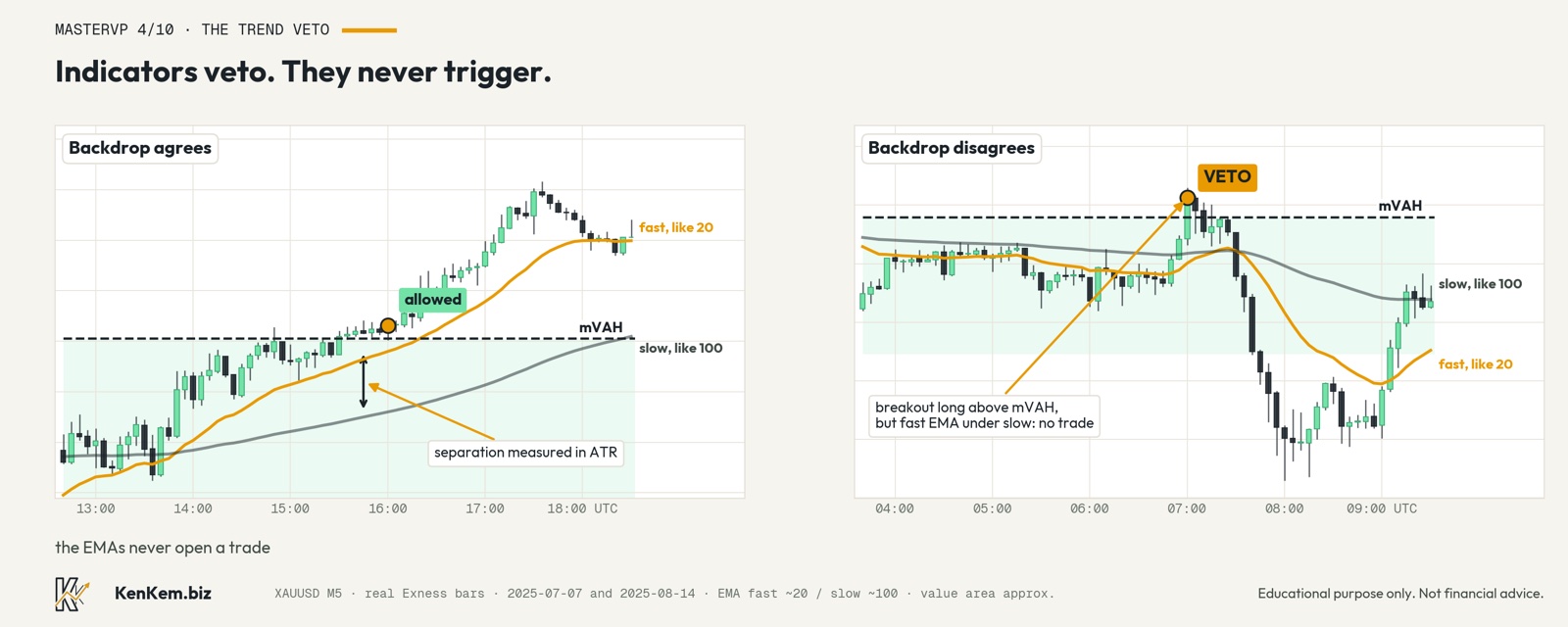
The trade always starts from the volume structure: one of the four setups from chapter 6, a close beyond the buffer from chapter 7. Only then does the trend check get a vote, and it can only vote against.
It uses a fast and a slow EMA, think of something like 20 and 100. If a breakout long fires while the backdrop is clearly bearish, the fast average below the slow one and well apart, the veto refuses it. Same for a breakout short into a clearly bullish backdrop. The exact lengths and thresholds stay in the Expert Advisor, but the mechanism is exactly this.
The detail that matters most is how "clearly" gets measured. Two averages can be ordered correctly while sitting on top of each other, which is a market that has decided nothing. Or they can be ordered correctly and cleanly apart, which is a market with a direction. A simple crossover check calls both "aligned". So the gap between them is divided by ATR. Measured that way, the reading means the same thing in a quiet session and a violent one, and it collapses toward zero in chop, exactly when a crossover starts to flicker. That is chapter 4 again: ATR is the unit.
There is also a momentum veto in the EA, RSI-style, and it ships switched off by default. It is an option for people who want an extra brake, not a reason anything trades.
What the veto costs
A trend filter refuses trades at turning points by design. The very first breakout of a new trend often fires while the slow average still points the old way, so the veto blocks some of the best trades of a reversal. I accept that. The trades it blocks more often are breakouts against a strong backdrop that fail and come straight back into value.
It can also be wrong for longer than feels reasonable. A backdrop read from two averages is still a summary of the past. It reduces the number of fights the system picks with the trend. it doesnt predict the trend.
A related lever I tested
In my September 2026 research I tested a buy-only version of the 10-minute system as a drawdown lever. It passed 4 of 4 checks, on both brokers and both test windows, at matched drawdown. It ships as a selectable preset, not the default, because a direction filter is a choice about which risks you want, not a free improvement.
Why this is the honest version
You may have seen people say MasterVP uses "no indicators at all". That would be false, and the user guide would contradict it. The true statement is narrower and more interesting: nothing enters because an indicator said so. The decision starts at the volume structure and the flow around it, and the indicators can only refuse.
The takeaway
If your strategy enters on an indicator signal, try flipping its role for a week of review: let the volume structure or price location propose the trade, and let the indicator only veto. Count how many of your losing trades the veto would have refused, and how many winners.
Which indicator on your chart is actually triggering trades, and would you still keep it if it could only say no?
From discretionary to systematic, part 8 of 15.
Previous: MasterVP 3/10: the entry. Why a breakout must clear value by about half an ATR
Next: MasterVP 5/10: the stop, and what "1R" really means
Part 8 of the From discretionary to systematic series, also published as an X Article. Educational purpose only. Not financial advice. Figures cited are backtest and research results unless stated as live, and past performance does not guarantee future results. Every trader remains responsible for their own risk settings and decisions.