MasterVP 10/10: the live account in the open, and why I only check the bots now and then
· #mastervp #live-trading #transparency
A backtest, however careful, is an argument. A real-money account that anyone can watch, including the bad weeks, is evidence. So instead of curating results, I opened the whole account.
MasterVP · Systematic Trading Journey
Part 14 of 15: From discretionary to systematic
This is the last MasterVP chapter, and it answers the fairest question anyone can ask about everything in the previous nine: does it work outside the lab? The honest answer is that it is too early to know, and the way I handle that matters more than any number I could quote.
Why the whole account
Sharing wins and losses without the system behind the decisions mostly manufactures FOMO. It does not help anyone, and it cuts both ways: a posted loss with no method attached is as empty as a posted win. So I wrote the method down first, in chapters 5 to 12, and only then opened the live record.
The bot has not been live long enough to prove robustness. I agree with that criticism completely. My answer is not to argue with it, but to remove my own ability to cherry-pick. One Exness account and one FundedNext account run release 1.26 forward, both published on Myfxbook, and the Exness account has been live with real money since early September 2026. Good weeks and bad weeks are on the same page, and nothing I say here can change what is on it.
I dont quote live returns in posts, on purpose. Weeks of live data are not evidence of anything yet, and a number pulled out of a young account reads like a promise. The account itself is the disclosure. Read it there, with its drawdown and its trade count next to everything else.
How long before it means something
Not days. Not weeks. Months. My own rule of thumb is roughly six months before the statistics start to say much, and a lot longer before they say anything firm. The backtest sample on the 5-minute leg alone is 1,643 trades, which after fat tails is worth about 512 independent observations. A live account needs time to collect even a fraction of that.
The rule to stop, written first
This is the part I am proudest of, and it is the part almost nobody publishes. Before any live data existed, I wrote down when each leg gets switched off.
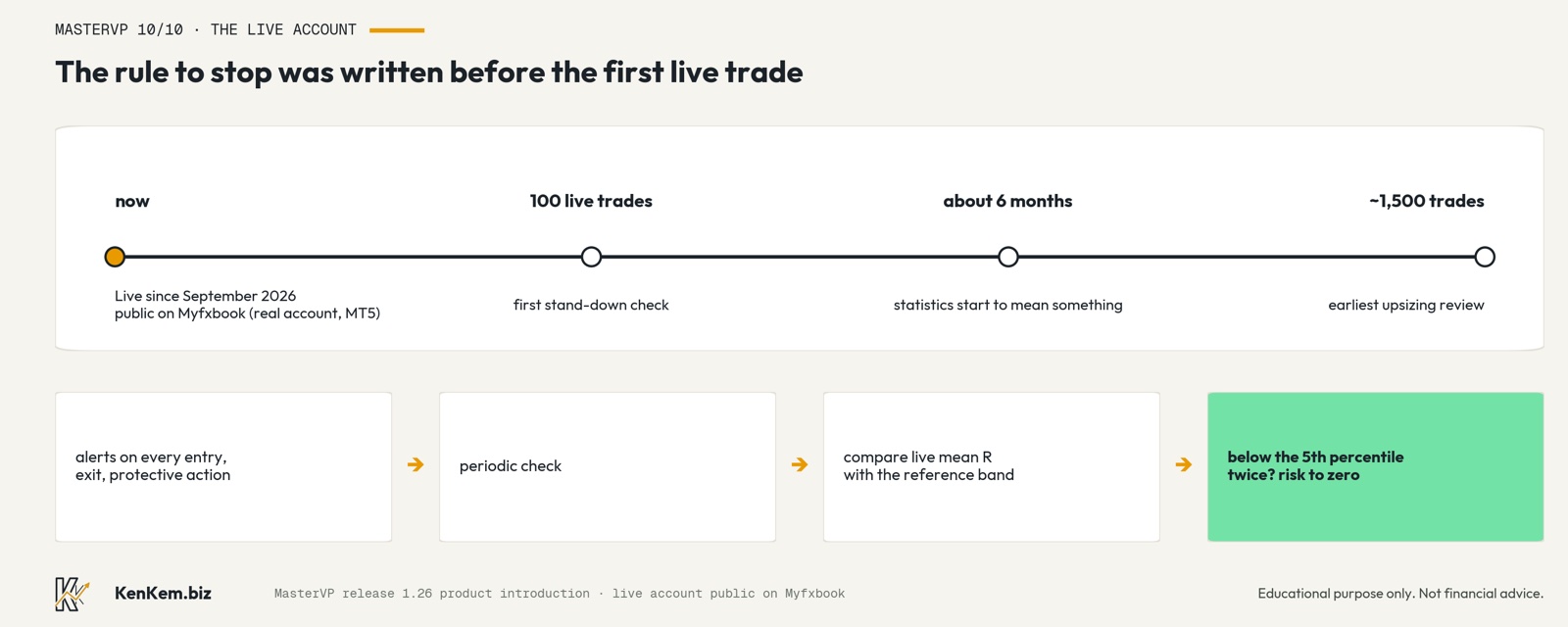
For each leg on each account, after 100 live trades: if the average result per trade, in R, sits below the 5th percentile of that leg's own reference test on two consecutive readings, that leg's risk goes to zero on that account.
There is no matching rule to increase size. The live record has to earn that over roughly 1,500 trades.
Writing it in advance matters because, once money is on the line, every losing streak comes with a story about why it is temporary. A threshold decided in daylight, before the first trade, does not listen to stories. It is the same reason I write entry rules before trading them: a decision made in advance is the only kind that is not made by the mood of the moment.
Why I only check the bots once in a while
People are surprised that I dont watch the live account every day. The reason is structural, not lazy.
Every entry, exit and protective action sends an alert, by Discord, Telegram or email. Every deployment is a binary and preset pair proven by an automated replay before it goes live, and after a migration the EA's configuration echo, effective risk, preset fingerprint and guard ladder, is read back to confirm what production is really running. The guard ladder from chapter 12 acts on its own, whether I am looking or not.
And silence is normal. On the shipped book, the median gap between entries in market hours is 1.6 hours, the 95th percentile is about a day, and the longest gap was 91 hours. A quiet two days is the habitat filter doing its job, not a broken bot. Knowing those numbers is what stops me from "fixing" a system that is simply waiting.
So my checks are periodic and specific: compare the live trades to the reference distribution, read the journal for errors, confirm the guard ladder. Not stare at the equity line and react to it. Watching every tick is how a discretionary trader sneaks back into a systematic process.
What this costs me
Openness has a price. When the account is in a drawdown, everyone can see it, and I cannot explain it away. That is the point. A ledger that goes quiet during bad weeks is a curated ledger, and a curated ledger is just a nicer screenshot.
It also means accepting that the live result may disappoint for a while even if the system is fine, because a strategy carried by rare large trades can go a long time without one.
Where this leaves the book
Ten MasterVP chapters, one sentence: a map of value, four setups, an entry buffer, a trend veto, a stop measured in R, a break-even checkpoint, an exit that lets winners run, rules for when not to trade, stress tests that include a failure, and a live account nobody can curate, me included.
The TradingView indicator shows that read and leaves the order with you. The MT5 Expert Advisor executes it on the settings and risk limits you configure. Both are at kenkem.biz, along with the free tools in the last chapter.
The takeaway
If you run a strategy with real money, write your stop-the-strategy rule now, before the next losing streak gives you a reason to soften it.
What would make you switch off your own strategy, and is it written down anywhere?
From discretionary to systematic, part 14 of 15.
Previous: MasterVP 9/10: consistency under stress. Spread, slippage, delay, two separate windows
Next: Start here: the free open-source tools I published, and a path to systematic trading
Part 14 of the From discretionary to systematic series, also published as an X Article. Educational purpose only. Not financial advice. Figures cited are backtest and research results unless stated as live, and past performance does not guarantee future results. Every trader remains responsible for their own risk settings and decisions.